Another round of hiring goals, another set of open roles to fill. You know the drill: post jobs, screen candidates, coordinate interviews, extend offers. But execution matters as much as intent, and the difference between a smooth hiring process and a chaotic one often comes down to whether you're following a structured approach or winging it as you go.
The hiring process isn't just about filling seats but about building a reliable system that protects quality, speed, and candidate experience simultaneously. When any of those three slip, you're either dealing with bad hires, missed deadlines, or candidates who drop out mid-process. Here's your Q1 hiring process checklist to keep you on track.
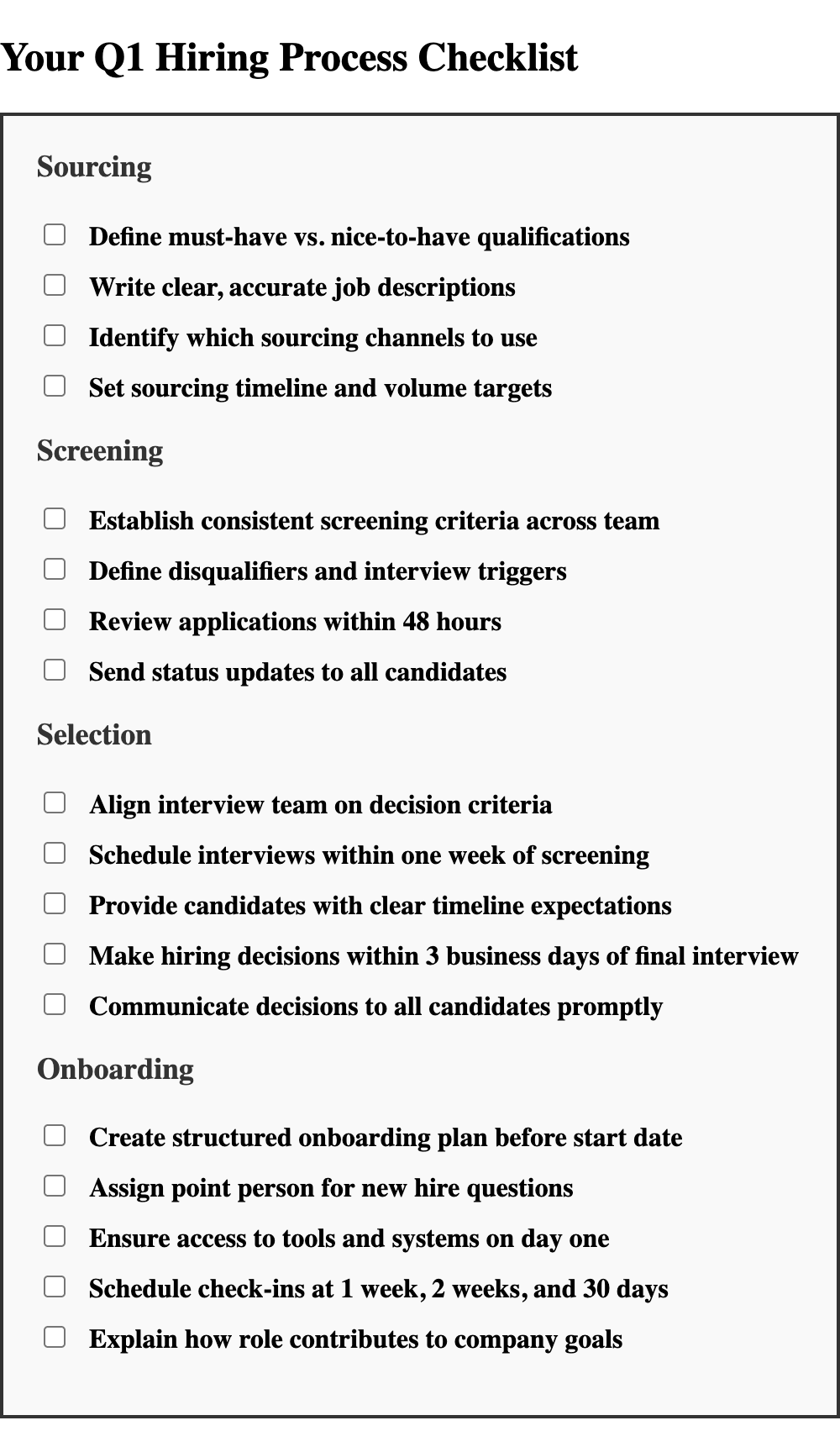
Your Q1 Hiring Process Checklist
Use this checklist to keep your hiring on track from initial sourcing through onboarding. Each phase includes the key actions that protect quality, speed, and candidate experience.
Read More: Why Pre-Hiring in December Gives You a Head Start on Next Year’s Roles
How to Use This Checklist to Avoid Common Mistakes
The checklist above covers the essential steps, but execution depends on avoiding predictable bottlenecks at each phase. Here's where hiring processes typically break down and how to stay on track.
Start with Clear Requirements
Vague job descriptions slow your sourcing before you've even posted the role. If your requirements list everything a hiring manager might want rather than what's actually necessary, you'll attract the wrong candidates or struggle to attract any at all.
Before you source, clarify must-have qualifications versus nice-to-haves. The clearer your requirements, the faster you can identify qualified candidates and move them through screening.
Use Consistent Screening Criteria
When different team members evaluate candidates using different standards, you create bottlenecks during the review stage. One interviewer prioritizes technical skills, another focuses on culture fit, and no one's sure which candidates should advance. Establish screening criteria before you start reviewing applications.
Define what disqualifies a candidate immediately and what earns them an interview. New hires are 50 percent more productive when they go through standardized processes, and that includes how you evaluate them during screening.¹ Consistency protects both speed and quality.
Read More: Diversity by Design: The Role of Blind Recruitment in Preselection
Align Your Team on Decision Criteria
Beyond screening, your interview team needs to agree on what qualifies someone for an offer. If one manager is looking for someone who can start contributing immediately while another prioritizes long-term potential, you'll end up in endless deliberation after final interviews.
Before you bring candidates onsite or into final rounds, define what a successful hire looks like for this specific role. What skills are non-negotiable? What trade-offs are you willing to make? When everyone's evaluating against the same standards, decisions happen faster and with more confidence.
Set Realistic Timelines and Stick to Them
Internal delays kill candidate interest as much as poor communication does. If your interview process requires sign-off from five people across three departments, build that into your timeline from the start. Don't promise candidates a decision in one week if your approval process realistically takes three.
When you set a timeline, honor it. If something changes and you need more time, communicate that immediately rather than going silent. Candidates remember how you treated them during the hiring process, and delays without explanation signal disorganization.
Communicate Throughout the Process
Poor communication is the top reason candidates withdraw their applications, cited by 47 percent of survey respondents.² This includes taking too long to respond after interviews, failing to provide clear timelines, or leaving candidates guessing about next steps.
Top candidates are often evaluating multiple opportunities simultaneously, and silence signals disinterest. Set expectations upfront about when candidates will hear back, and follow through. If your timeline changes, communicate that too. Speed matters, but clarity matters more.
Document Your Process for Future Hires
If every hire requires rebuilding the process from scratch, you're wasting time and introducing inconsistency. Document what worked: which sourcing channels produced quality candidates, what interview questions revealed the most useful information, how long each stage actually took.
This doesn't mean every future hire follows an identical path, but you should have a baseline process that you refine over time rather than reinventing it each cycle. Documentation also makes it easier to onboard new hiring managers or bring in staffing partners who need to understand your standards.
Read More: 4 Hiring Lessons from 2025 to Boost Your 2026 Strategy
Don't Treat Onboarding as an Afterthought
You can execute a perfect hiring process and still lose people in the first 90 days if onboarding is weak. Employees are 58 percent more likely to stay with a company for three years if they go through structured onboarding.¹
This isn't just about paperwork, it's about new hires understanding their role expectations, knowing how their work connects to company goals, and having clear pathways for support. Build an onboarding plan that extends beyond day one. Check in regularly during the first month, assign a point person for questions, and make sure new hires understand how their work contributes to larger goals.
Read More: The Silent Killer of Workforce ROI: How Poor Onboarding Costs You Thousands
Allied OneSource Can Help You Start Q1 Hiring with Confidence
Following a structured hiring process protects quality, speed, and candidate experience but executing it consistently while managing daily operations is challenging. Allied OneSource helps you stay on track with expert support across sourcing, screening, and onboarding.
Whether you need help filling roles in call centers, manufacturing, IT, or administrative functions, we bring process discipline and industry expertise to every placement. Let's streamline your Q1 hiring today.
References
1. Kosinski, Matthew. Onboarding: The Key to Elevating Your Company Culture. SHRM Executive Network, 30 May 2023, https://www.shrm.org/executive-network/insights/onboarding-key-to-elevating-company-culture.
2. Navarra, Katie. “Why Your Candidates Are Dropping Out.” SHRM, 21 Mar. 2024, https://www.shrm.org/topics-tools/news/talent-acquisition/why-your-candidates-are-dropping-out.