When a staffing partner stops delivering the results you need, the instinct is to end the relationship and bring in someone new. A missed deadline, a candidate who did not work out, or slower fill times can make switching seem like the obvious move. But switching creates costs that are easy to overlook.
Every switch carries a cost that rarely appears as a line item because it is spread across onboarding time, productivity losses while a new vendor gets up to speed, and institutional knowledge that does not transfer from one partner to the next. Before making another switch, those costs deserve consideration.
Why Switching Feels Like the Obvious Fix
Ending a staffing relationship that is not working feels like a decisive action. A new vendor's pitch promises better results, and staying with a partner who is falling short can feel like accepting the status quo.
The instinct is understandable. You want better results, and a fresh start appears to be the fastest path. But changing staffing partners doesn't only replace one relationship with another. It also sets off a series of operational costs that are easy to overlook until the transition is underway.
What a Vendor Switch Costs You
The costs below show up in your timeline, your fill rates, and the operational knowledge your workforce relies on every day.
Re-Ramping Costs More Than It Looks Like
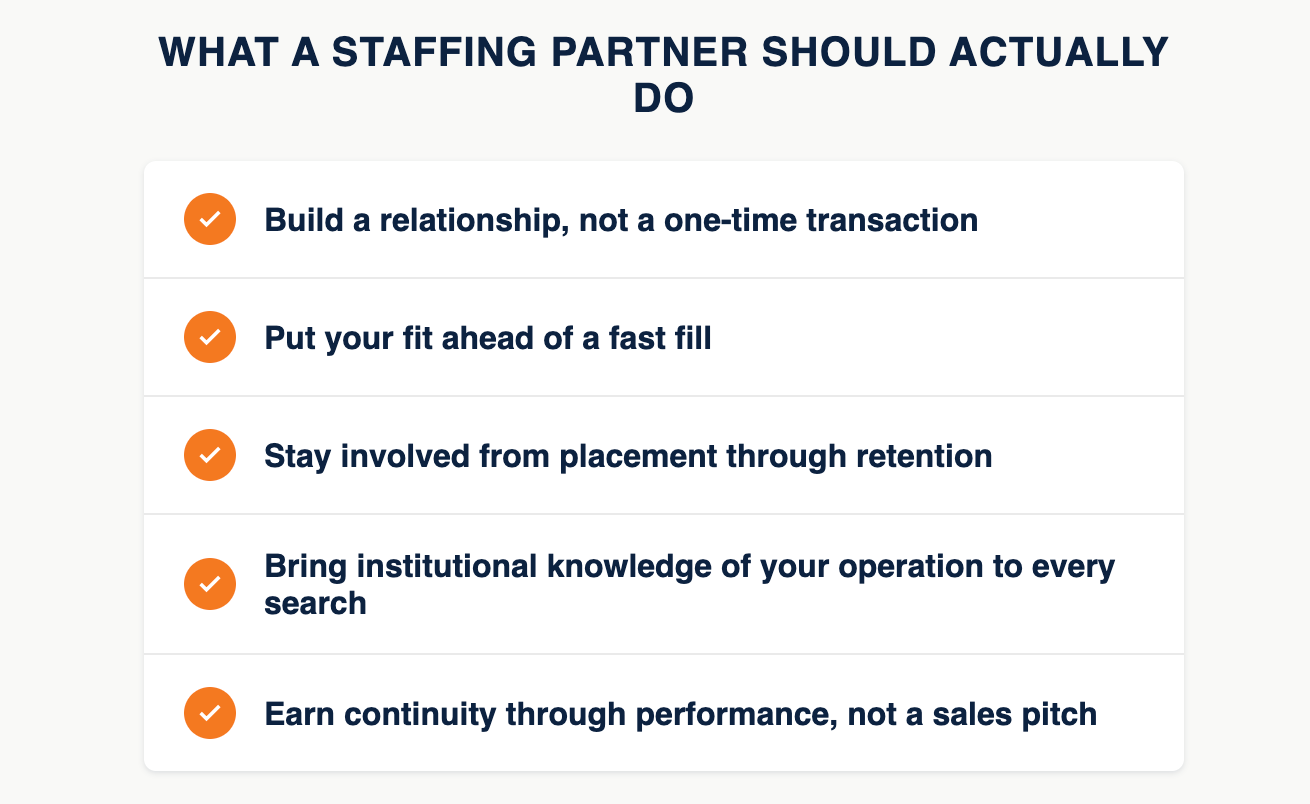
A new staffing partner needs time to learn your business before they can perform at the level your previous partner eventually reached, regardless of how that relationship ended. That learning curve is not a formality. It includes understanding your operation, shift structure, hiring standards, and the characteristics that predict long-term success in your environment.
Most of that knowledge is not documented. It is built through experience. During that ramp-up period, productivity slows while your new partner learns what your previous partner already knew. You are not only replacing one staffing partner. You are rebuilding the operational knowledge that partner developed over time.
Read More: RPO Explained: Why Companies Are Adopting It
Open Roles Sit Longer During the Transition
Your fill rate does not remain steady during a vendor transition. A new staffing partner does not inherit an existing candidate pipeline. They begin sourcing from scratch, which means open positions remain unfilled while that pipeline is rebuilt.
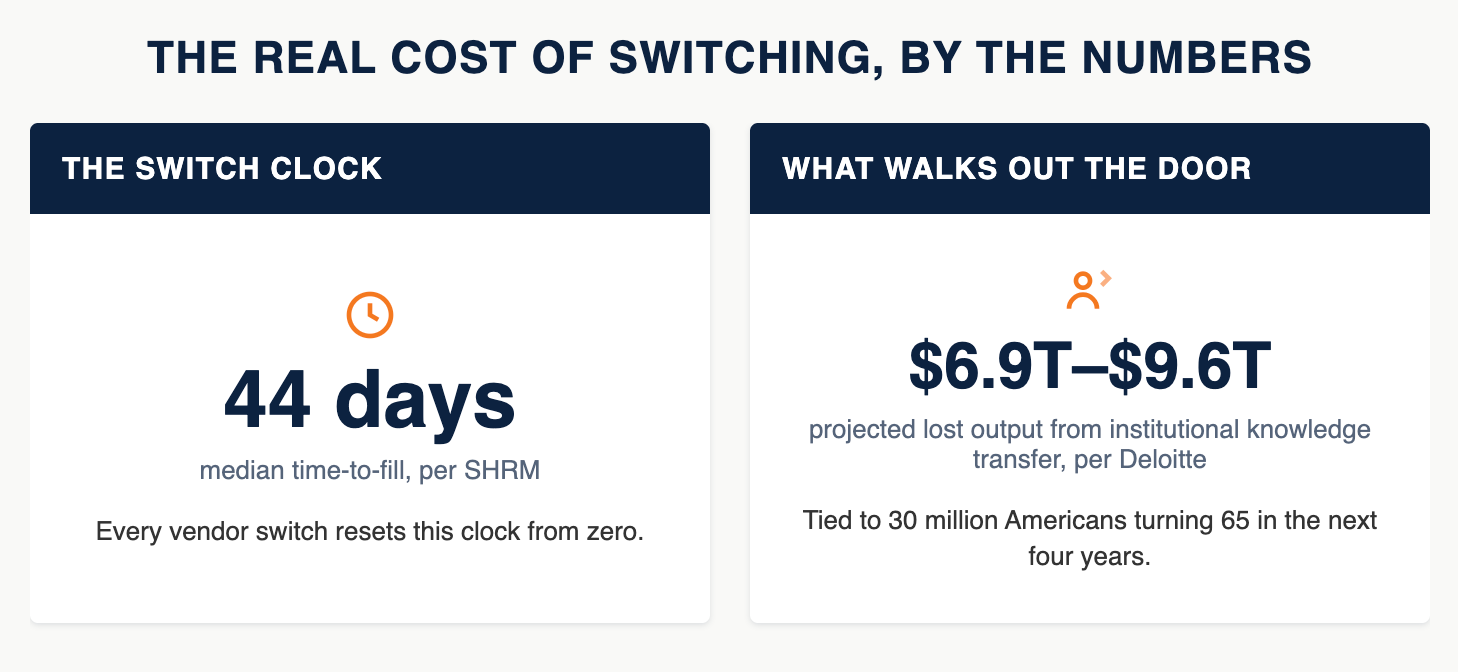
The Society for Human Resources' (SHRM) 2025 Benchmarking Report found that the median time-to-fill is 44 days.¹ Every vendor switch effectively restarts that process because the incoming partner has no candidates already sourced or vetted for your specific roles. Until that partner reaches full productivity, your operation absorbs the impact of longer vacancies.
Read More: High-Volume Hiring: Proven Strategies to Reduce Turnover Fast
Institutional Knowledge Doesn't Transfer With You
Your previous staffing partner knew which supervisors conducted demanding interviews, which shifts experienced higher attrition, and which candidate profiles consistently succeeded in your environment. That knowledge does not move to your next vendor. It stays behind, forcing the new partner to build it again.
Deloitte projects that as more than 30 million Americans turn 65 over the next four years, the resulting loss of institutional knowledge could reduce economic output by between $6.9 trillion and $9.6 trillion.²
That estimate reflects workforce-wide retirement trends rather than staffing vendor transitions. However, it illustrates the same principle: knowledge built through experience and relationships is difficult to replace once it is lost. Staffing partnerships are no different.
Read More: Fill the Gaps: Q1 Logistics and Warehouse Staffing Trends
Continuity Compounds Over Time
Frequent vendor changes create a cycle of constant rebuilding. Every new partner repeats the same learning process, preventing the relationship from reaching the point where accumulated knowledge improves hiring speed, candidate quality, and operational alignment.
At
Allied OneSource, long-term partnerships are the foundation of our approach. With roots dating back to 1898, we've spent more than a century helping employers build staffing relationships that grow stronger over time. As we learn your operation, hiring standards, and workforce, every search benefits from deeper operational knowledge instead of another reset.
If You Decide to Switch, Make It Count
Sometimes switching staffing partners is the right decision. But if you're going to invest the time and effort that comes with starting over, make sure it's for a partner you can build with over the long term.
At Allied OneSource, we don't believe a staffing partnership should end in another reset. We invest the time to understand your business, strengthen your hiring process, and deliver better results over time, so every search benefits from deeper knowledge instead of starting from scratch.
Make your next staffing partner your last. Build your partnership with Allied OneSource.
References
1. Deloitte. "Develop and Execute a Knowledge Management Plan." Deloitte Insights, 2026, www2.deloitte.com/us/en/insights/topics/talent/knowledge-management-plan.html.
2. Society for Human Resource Management. "SHRM Releases 2025 Benchmarking Reports: How Does Your Organization Compare?" SHRM, 16 Oct. 2025, www.shrm.org/about/press-room/shrm-releases-2025-benchmarking-reports--how-does-your-organizat.