
If you were asked right now what your staffing partner's fill rate is, could you answer? Most employers can rattle off cost-per-hire or time-to-fill without much thought, since those numbers show up on invoices and in day-to-day frustration when a search drags on.
Fill rate rarely gets the same attention, even though it is the number that tells you whether your partner's process works. By the time a fill rate problem becomes visible, a shift goes uncovered, or a line runs short, costing you in overtime or lost output. Fill rate is not just a number to glance at. It is a diagnostic.
Why Fill Rate Goes Untracked
Fill rate is often overlooked, even though it is one of the clearest signals of how well a staffing partner is performing. Cost-per-hire gets tracked because it shows up on an invoice. Time-to-fill gets tracked because hiring delays are visible and frustrating, especially when roles stay open longer than expected.
Fill rate is less visible. It does not stand out the way a missed deadline or an unfilled role does. Instead, it shows up as a pattern over time: requisitions that go unfilled, positions that take longer to staff, or roles that are eventually filled with less-qualified candidates. Those issues rarely point to a single, obvious problem, making them easy to overlook.
Because few organizations ask their staffing partner to report fill rate, many vendors do not include it in their performance reporting.
That gap in reporting often goes unnoticed until you start asking what it is actually hiding.
What Fill Rate Tells You
Once you know what to look for, fill rate stops being an abstract metric and becomes a clear indicator of how consistently your staffing partner is meeting your hiring needs.
A Mediocre Fill Rate Is More Common Than You'd Think
Fill rate is one of the clearest measures of whether your staffing partner is consistently finding and placing qualified candidates for the roles you need to fill. A low fill rate is rarely the result of bad luck. It usually means requisitions are going unfilled or being filled with weaker matches than you need, pointing to shortcomings in how candidates are sourced, screened, or matched before they ever reach you.
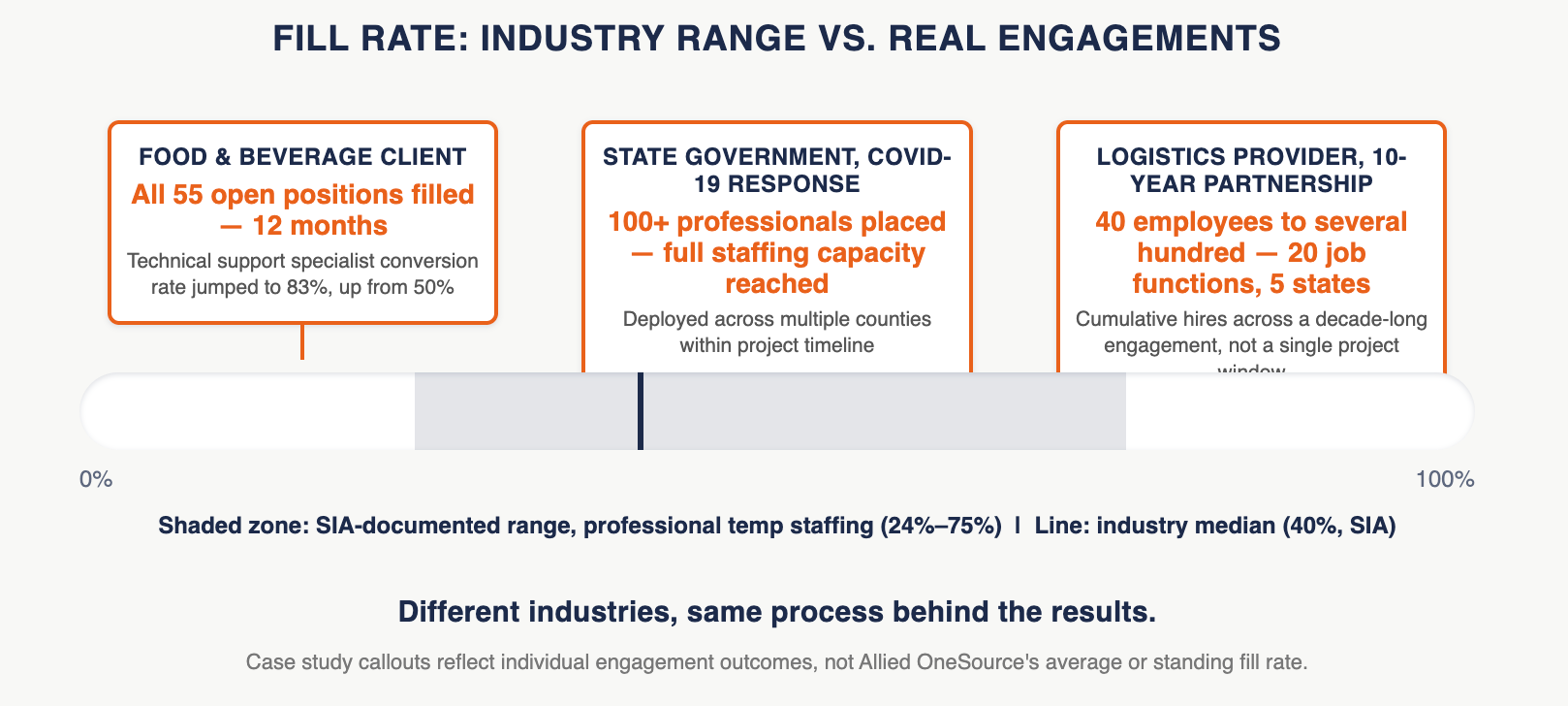
Even broader workforce data shows how common this problem is. Staffing Industry Analysts reports that the midrange fill rate for professional temp staffing spans 24% to 75%, with a median of just 40%.¹
That median suggests many staffing partnerships fail to fill a significant share of the roles they are asked to support. If your fill rate falls anywhere near that range, the impact is likely already visible through longer vacancies, missed productivity, or greater pressure on your existing team.
A Gap Shows Up as Overtime and Uncovered Shifts, Not a Line Item
A low fill rate rarely appears as a standalone metric in day-to-day operations. Instead, its impact is reflected in overtime for staff who are already stretched thin, missed production runs, or supervisors stepping away from their own responsibilities to cover shifts that should have been filled. Those costs are rarely linked back to the staffing partner's inability to fill open roles, which is one reason the problem often goes unnoticed.
Speed and reliability also tend to move together. Bullhorn's 2026 benchmarking data shows top-performing staffing firms placing candidates in under 10 days on average, with the fastest segment averaging three days or less. Firms averaging 10 to 19 days saw weaker performance, a gap that correlated with revenue loss in 2025.²
A slower placement timeline is not just an inconvenience. It often reflects the same sourcing and screening challenges that lead to a lower fill rate in the first place.
You Won't Find Out Until It's Already Cost You
Without proactively tracking or requesting fill rate, the first indication of a problem is rarely an early warning. Instead, it is the operational consequences: gaps in the schedule, overtime costs appearing in payroll, or production falling behind because roles were not filled when they needed to be. By the time those issues become visible, low fill rate has often been affecting your operation for weeks or months.
The fix is not complicated. It does not require a new system or a different way of measuring your operation. It requires asking your staffing partner for their fill rate before you sign or renew a contract and treating both their answer and their willingness to share it as useful information.
Ask for the Number Before You Sign
Most staffing partners never volunteer fill rate, show rate, or 90-day retention metrics, and most employers never ask for them. Without those numbers, it is difficult to tell whether uncovered shifts are isolated incidents or signs of a recurring performance issue.
A vendor that will not share how often it successfully fills the roles it accepts is asking you to evaluate its performance without one of its most important indicators.
Allied OneSource publishes these results because they hold up under scrutiny.
- For one food and beverage client, that meant filling all 55 open positions within 12 months, with technical support specialist conversions under a temp-to-hire model climbing to over 83%, up from the client's prior 50% rate.
- A state government needed COVID-19 tracking teams deployed fast, and Allied OneSource placed over 100 qualified professionals across multiple counties, reaching full staffing capacity within the project timeline.
- A decade-long logistics partnership tells a similar story, growing the client's workforce from 40 employees to several hundred across 20 job functions and 5 states.
Do You Know Your Staffing Partner's Fill Rate?
If you don't know your staffing partner's fill rate, show rate, or 90-day retention rate, now is the time to ask.
At Allied OneSource, we believe staffing performance should be measurable. That's why we openly share the metrics that matter, so you can make informed staffing decisions based on performance, not promises.
Contact Us to discuss the staffing metrics we track and how they can help you evaluate your current staffing strategy.
References
1. Staffing Industry Analysts. "Best Staffing Companies to Work For." SIA, 2025, www2.staffingindustry.com/Editorial/Daily-News/Best-staffing-companies-to-work-for.
2. Bullhorn. "2026 GRID Industry Trends Report." Bullhorn, 2026, www.bullhorn.com/resources/2026-grid-industry-trends-report/.