
Q1 ends and most warehouse operations finally exhale. The holiday surge is over, backfill has slowed, and headcount feels stable, at least for now. That exhale is exactly where most operations lose ground.
Q2 isn't recovery time. It's the one quarter where you have enough breathing room to hire deliberately instead of desperately. By the time Q3 demand climbs, Prime Day in mid-July, back-to-school inventory builds starting in May, the window to build and train a capable team has closed.
The operations that use Q2 well don't feel Q3 pressure the same way. The ones that treat it as a slow period spend the rest of the year reacting.
What Actually Happens to Your Workforce After Q1
The post-peak period looks like stability on paper. What's happening underneath is a different story.
Warehousing and transportation account for 6.6 million jobs, roughly 5% of all private sector employment and the sector's seasonal nature means quits and discharges naturally concentrate around demand shifts, including the post-peak window after Q1.¹ The team you have in April is rarely the same one that carried you through the surge.
Tariff volatility and supply chain fragmentation in 2026 are making hiring mistakes more expensive. Operations have less margin for a bad fit than in previous years, with cost optimization now a top priority across the industry.²
Many operations receive approved headcount in Q2 but don't act on it until Q3, which eliminates the timing advantage entirely and puts them back in reactive hiring mode when demand is already climbing.
Why Q2 Hiring Hits Different
This isn't about moving faster. It's about moving when the conditions actually let you hire well.
You Have Time to Train Before Q3 Demands It
Amazon Prime Day lands in mid-July. Retail inventory builds for back-to-school start as early as May. A forklift operator hired in April is productive by the time those demands hit; someone hired in July is still in onboarding when you need them most.
The math on getting this wrong is unforgiving. The average cost-per-hire for non-executive roles in 2025 was $5,475, and replacing a mis-hire runs anywhere from 40% to 200% of that worker's annual salary.³ Rushing hires to meet Q3 demand doesn't solve the capacity problem. It delays it and multiplies the cost.
Your Talent Pool Is Less Competitive Right Now
Post-peak, workers who left or were displaced from Q4 and Q1 surge roles are actively available. Experienced fulfillment associates, forklift operators, and DC leads are on the market before competing operations start posting aggressively for Q3.
By July, you're fighting for the same candidates as every other warehouse that waited. Hiring in Q2 means recruiting from a larger, less competitive pool and having enough time to be selective rather than just fast.
How to Use Q2 Before the Window Closes
The advantage Q2 gives you is time but only if you use it for things you genuinely cannot do when demand is already climbing.
Audit Your Workforce Before You Post a Single Role
Right now, you have clear visibility into who stayed, who's disengaged, and where your actual gaps are not guessing gaps based on last quarter's chaos. Map your existing team against Q3 projected volume before spending anything on recruiting.
Replacing a warehouse worker costs between six and nine months of their salary when you factor in lost productivity, recruiting expenses, and training time. Knowing who you're at risk of losing before you lose them is the only way to make that math work in your favor.
Cross-Train Now, Not During the Surge
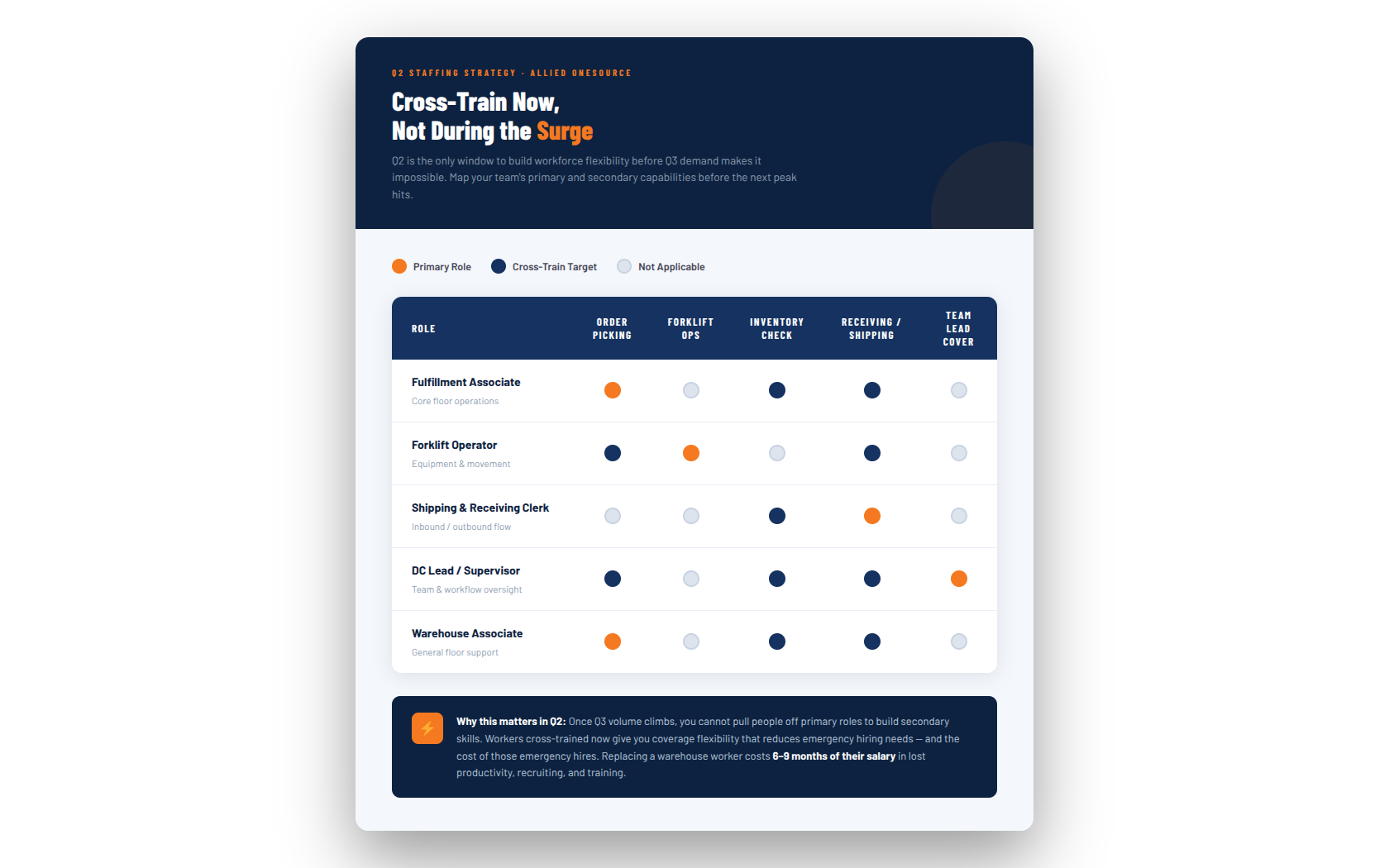
Cross-training fulfillment associates, forklift operators, and DC leads across functions is a Q2-only opportunity. Once Q3 volume climbs, you cannot pull people off primary roles to build secondary skills.
Workers cross-trained now give you coverage flexibility that reduces emergency hiring needs later — when one area of your operation is short, you have people who can shift rather than gaps you have to fill from outside.
Benchmark and Adjust Compensation Before Competitors Do
Q2 gives you the data from Q1 who you lost, what it cost to replace them, and whether your wage ranges held up against the market. Adjusting now, before Q3 hiring competition heats up, is a move you can only make from a position of time. Forklift operators nationally range from $25.36 to $47.62 per hour, and distribution center workers range from $29.39 to $50.61 per hour.
If your ranges sit below market, Q2 is when you correct that not July, when candidates are already fielding competing offers. For more salary information, download our Salary Guide.
Build Your Staffing Partner Relationship Before You Need It
The advice isn't simply to use a staffing partner. It's to vet, onboard, and establish agreements with one now, so that when Q3 demand spikes you're deploying pre-qualified talent in days rather than restarting a vendor relationship under pressure.
Staffing specialists who maintain pre-vetted talent pools across fulfillment, distribution, and logistics roles can deliver hires in three to five days. That speed only works if the relationship and onboarding process are already in place before the urgency hits.
Allied OneSource Can Help You Staff Smarter
Q2 doesn't announce itself as a critical window; it just quietly closes. Allied OneSource helps warehouse and logistics operations build the workforce they need before demand makes it urgent. From pre-vetted talent pipelines and flexible staffing models to compensation benchmarking and retention support, we work with you during the quiet periods, so your operation doesn't scramble during the loud ones.
Ready to get ahead of Q3? Let's talk.
References
1. Allard, Mary Dorinda, and Kennedy Keller. "Keeping America Moving: Employment in Transportation and Warehousing Industries." Bureau of Labor Statistics, July 2024, www.bls.gov/spotlight/2024/keeping-america-moving-employment-in-transportation-and-warehousing-industries/home.htm.
2. Neuffer, Phil. "5 Supply Chain Management Trends to Watch in 2026." Supply Chain Dive, 8 Jan. 2026, www.supplychaindive.com/news/supply-chain-trends-risks-2026-retail-manufacturing/808797/.
3. "The Hiring Mistakes That Burn Cash and How to Fix Them." Forbes Advisor, Forbes Advisor Brand Group, www.forbes.com/advisor/business/the-hiring-mistakes-that-burn-cash-and-how-to-fix-them-sponsored/.