A fully staffed operation feels like the safest position to be in. Your shifts are covered, headcount looks right on paper, and there’s no immediate pressure to hire. The problem is that a fixed roster is sized for one version of your operation; the average one. When demand spikes, that roster has no room to flex, so overtime becomes the default response.
When demand dips, you’re carrying labor costs the work doesn’t justify. Either way, the model is working against you. We'll cover how flexible staffing models align your workforce to actual operational demand, and why that alignment matters more than headcount alone.
What a Fixed Staffing Model Actually Costs You
The cost of a rigid staffing model doesn’t show up as a line item; it shows up in overtime, absences, and productivity gaps that compound quietly over time.
Your Staffing Model Is Already Building in Overtime Costs
Permanent headcount sized for average demand means the moment volume spikes; overtime is your only lever. That’s an expensive default. Benefits alone add roughly 42% on top of base wages for every permanent private industry employee, so when overtime enters the picture, that cost multiplies fast.¹ For operations running on tight margins, this isn’t a contingency cost that surfaces occasionally. It’s a structural one that shows up every time demand outpaces your fixed roster.
Read More: Fill the Gaps: Q1 Logistics and Warehouse Staffing Trends
Burnout Is an Availability Problem, Not Just a Wellbeing One
In shift-heavy environments, burnout doesn’t stay personal for long. Employees experiencing workplace burnout have a 57% increased risk of absence greater than two weeks.² In a warehouse or distribution environment, that absence doesn’t disappear. It falls on whoever is left, which accelerates the same cycle in the rest of your team.
Flexible staffing reduces the workload concentration that creates that pattern in the first place. When your roster can expand to meet demand rather than leaning harder on the same people, you’re not just managing cost. You’re protecting the reliability of your existing workforce.
Read More: Peak Season Staffing: How to Retain Top Talent in Distribution Centers
Flexible Models That Actually Work
The right model depends on your operation but each of these gives you something a fixed roster can’t: the ability to match your workforce to your actual demand.
Contract-to-Hire
This model lets you evaluate candidates under real working conditions before making a permanent commitment. You get a worker who is already integrated into your operation, familiar with your processes, and proven under actual pressure rather than interview conditions.
Allied OneSource’s Contract-to-Hire model is built around this logic, pre-vetted candidates start as contractors and convert to permanent roles when the fit is confirmed on both sides. For roles where the wrong long-term hire creates significant downstream costs, that trial period is worth more than it might appear on a budget sheet.
Read About a Success Story: Catalyzing Growth: From 40 to 250 Employees in A Decade
Temp-to-Perm
Workforce costs scale with demand rather than running at a fixed rate during slower periods. Top performers see a clear path to permanent roles, which motivates stronger performance during the trial period. When they convert, they do so with full knowledge of your systems, culture, and expectations. That compresses the onboarding curve significantly compared to bringing in an external hire who is starting from scratch. For high-turnover roles, this model also creates a sustainable pipeline rather than a recurring recruitment problem.
Shift-Specific Staffing
Matching headcount to actual shift volume rather than running the same roster across all shifts reduces idle labor costs and prevents understaffing on your highest-volume windows. Pre-screened workers familiar with warehouse safety protocols and equipment operation can be deployed with minimal ramp-up time. This model works particularly well when volume is predictable by shift but variable across the week, you’re not guessing at coverage, you’re building it around what the data already tells you.
On-Demand Staffing for Surge Coverage
When demand spikes faster than anticipated; an accelerated client schedule, overflow volume, or unexpected gaps in your permanent team, internal hiring cannot respond in time. A staffing partner with pre-vetted talent pools ready for immediate deployment gives you qualified workers on-site within days.
The surge gets covered without permanent headcount commitments that outlast the demand itself. Once volume normalizes, you scale back without carrying costs the work no longer justifies.
Read More: A Deep Dive into The Impact of Recruitment Process Outsourcing (RPO) on Talent Acquisition
Which Model Fits Your Operation?
Each approach addresses a specific staffing challenge. This guide helps you match the model to your current gaps.
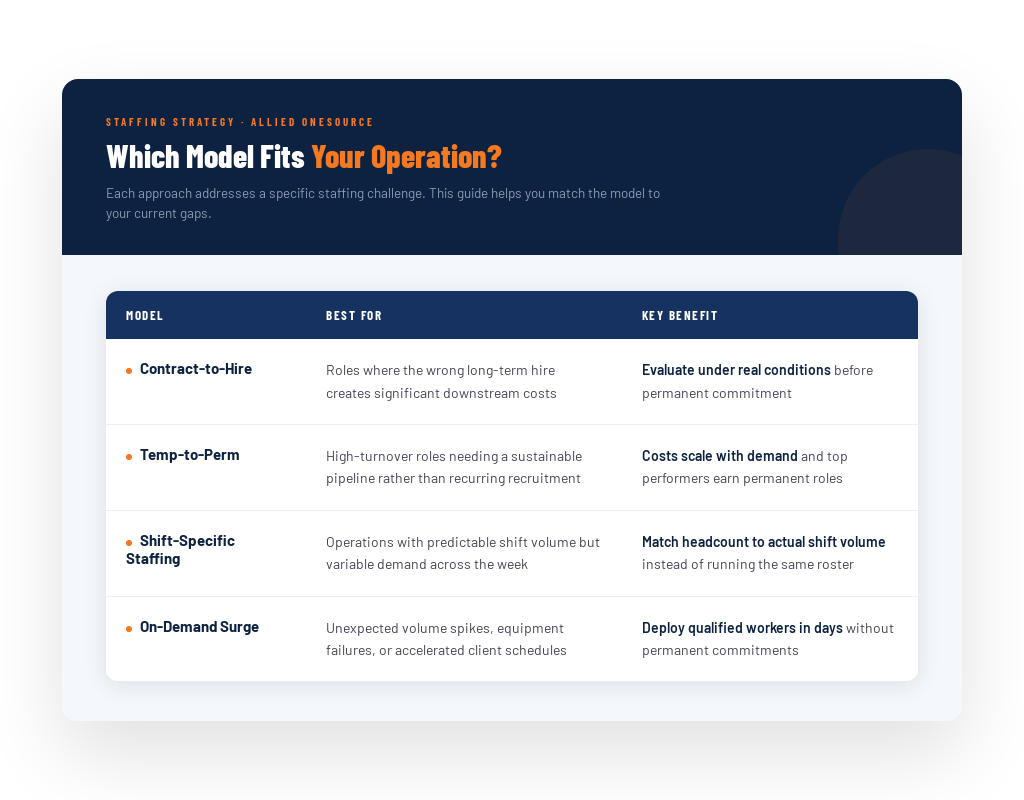
These models can be combined or adjusted based on seasonal demand, growth timelines, or operational shifts.
Allied OneSource Can Help Build a Workforce That Scales with Your Operation
A fixed roster may have made sense when demand was predictable. When it isn't, you need a staffing model that can flex and scale without breaking. Allied OneSource partners with operations leaders across industries to design staffing solutions based on real demand patterns, not assumed stability.
From light industrial and warehouse environments to administrative, IT, field technician and call centers roles, we tailor each model to fit your operation. Contract-to-hire when you need evaluation time before long-term commitment. Temp-to-perm to build sustainable talent pipelines. Shift-specific staffing to manage variable volume. On-demand support when surges hit fast and timelines are tight.
The result is a workforce structured to adapt as your operation changes, without compromising efficiency.
Ready to build a more responsive staffing model? Contact us today!
References
1. "Employer Costs for Employee Compensation – September 2025." Bureau of Labor Statistics, U.S. Department of Labor, 24 Feb. 2026, www.bls.gov/news.release/pdf/ecec.pdf.
2. "Employers Need to Focus on Workplace Burnout: Here's Why." American Psychological Association, 12 May 2023, www.apa.org/topics/healthy-workplaces/workplace-burnout.