
When a placed worker does not fit the role, the first question is usually about the sourcing. Before that question gets answered, it is worth checking whether the job order the recruiter was working from gave them enough to source against accurately. A job order is not a job description. A job description is written for candidates and covers the role at a high level.
A job order is the operational brief a recruiter sources against, and the more specific it is about shift structure, physical demands, required experience, and day-one expectations, the more precisely a recruiter can identify candidates who actually match the role. When that brief is vague, the sourcing that follows it will be too.
Why Vague Job Orders Produce Mismatched Placements
Most recruiters work with what they are given. When the brief is thin, the sourcing that follows it will be too, and the mismatch that results is traceable back to what the order did and did not communicate.
A Title and a Start Date Is Not Sourcing Criteria
A job order that lists a title, a pay rate, and a start date gives a recruiter one usable data point: the general category of worker to look for. It does not tell them which shift the worker needs to cover, what the physical demands of the role are, what prior experience is actually required versus preferred, or what the floor environment looks like day to day.
Gallup found that only 47% of employees strongly agree they know what is expected of them at work.¹ If that ambiguity exists even with a manager physically present, a job order that does not specify expectations gives a recruiter far less to work with than the role actually requires.
Include Why the Last Person Did Not Work Out
The detail most employers leave out of a job order is often the most useful one a recruiter can have: why the previous placement or employee in the role did not work out. If the last person left because the pace of the line was faster than expected, that is a screening criterion.
If they left because the shift changed after placement, that is a communication flag. If they struggled with a specific piece of equipment, that narrows the candidate profile. None of that information is negative or sensitive. It is operational context that helps a recruiter source more precisely the second time than the first.
What a Job Order That Actually Works Looks Like
A complete job order does not require a long document but the right details in the right places.
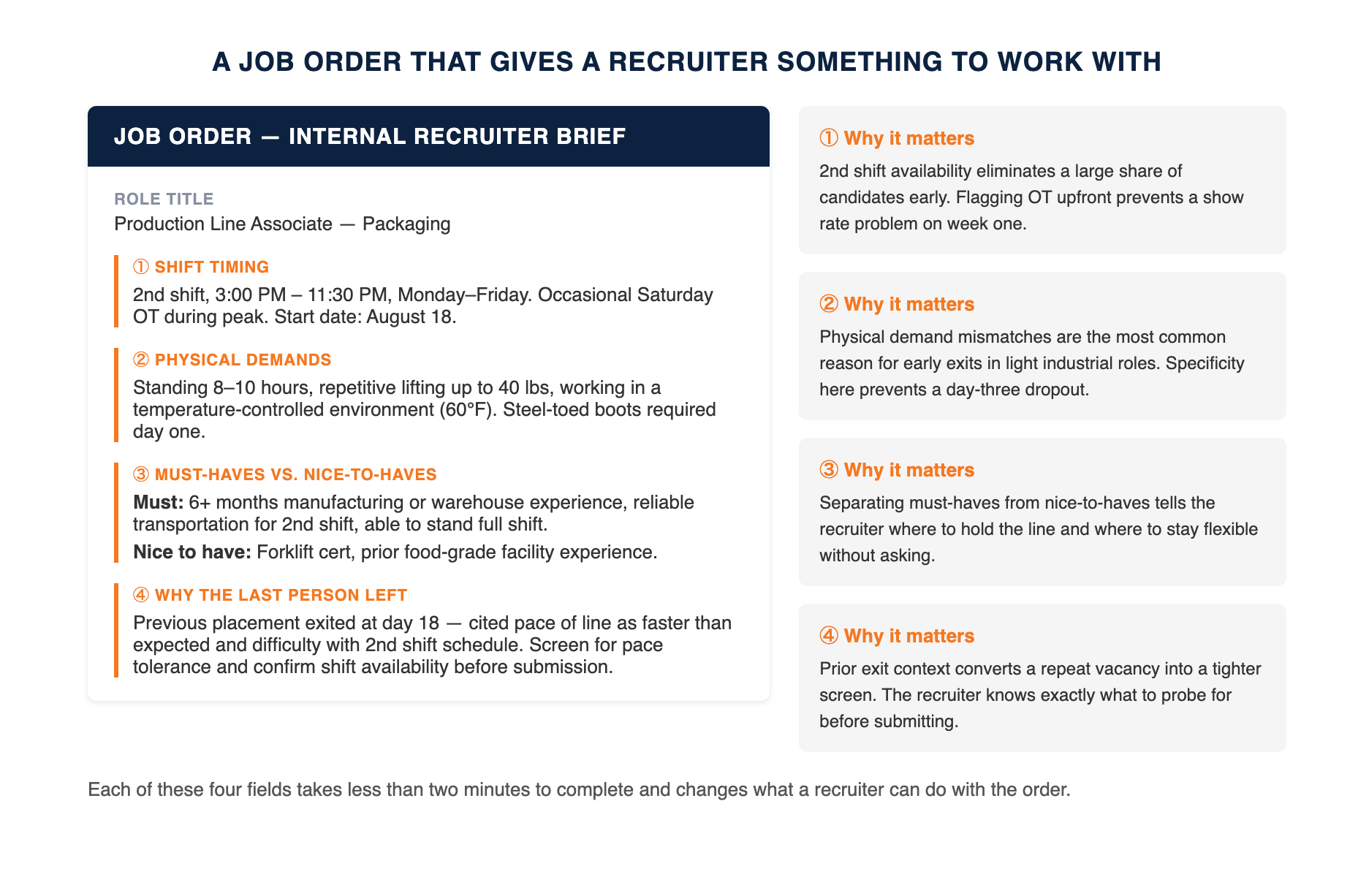
Ten Minutes on a Job Order Saves a Placement Later
The time it takes to complete a detailed job order is small relative to what a mismatched placement costs in overtime, retraining, and a reopened vacancy.
A Detailed Order Does Not Take Longer to Fill
The unstated concern with a more detailed job order is that it slows sourcing down. The opposite tends to hold. A recruiter working from a vague brief spends more time on candidates who do not fit because the criteria are broad enough to include them.
A recruiter working from a precise brief can eliminate mismatches earlier in the process and spend more time on candidates who actually match the role. The detail does not create more work for the recruiter. It redirects the work toward candidates worth submitting.
A Vague Order Is Where a Low Show Rate Starts
A candidate who accepts a placement without a clear picture of the shift timing, physical demands, or pace of the role is more likely to reconsider before day one. Show rate problems often trace back to a gap between what the candidate understood about the role during screening and what they encountered when they arrived.
A job order that communicates those details clearly gives the recruiter something specific to walk the candidate through before acceptance, which closes the gap before it becomes a no-show. For a closer look at what else drives show rate problems, Why Your Show Rate Is Low covers the full picture.
The Brief Is the Variable Most Employers Don't Check
Employers who receive a mismatched candidate and attribute it entirely to sourcing quality are making the same assumption that makes the next mismatch likely. The job order is the brief the sourcing was built on, and a weak brief produces a weak pool regardless of how experienced the recruiter is.
Recognizing the job order as a variable worth controlling is the same pattern of thinking covered in What Manufacturers Get Wrong About Staffing Agencies, where the assumption that all agencies perform the same way obscures the real differentiator, which is process.
The Best Placements Start Before Sourcing Does
Every placement that holds past 90 days traces back to a recruiter who knew exactly what to source against before submitting a single candidate. That precision starts with the job order, and it extends into how a staffing partner reviews that order with you before sourcing begins.

Allied OneSource works through job order clarity with every employer before a search starts, because a precise brief is what makes a precise placement possible. For employers evaluating what that partnership looks like from the start, How to Evaluate a Staffing Partner Before You Sign covers the full framework.
Before Allied OneSource Sources a Single Candidate, We Make Sure the Job Order Is Right
A mismatched placement almost always traces back to a brief that did not give the recruiter enough to work with. Allied OneSource sits down with you before sourcing begins to make sure the job order reflects what the role actually requires, the shift structure, the physical demands, the must-haves, and what did not work last time. That conversation is where good placements start. Let's have it.
Reference
1. Gallup. "Anemic Employee Engagement Points to Leadership Challenges." Gallup, www.gallup.com/workplace/692954/anemic-employee-engagement-points-leadership-challenges.aspx.