
When the same role opens for the third time in a quarter, the reflex is to source faster. The vacancy is visible, the pressure is immediate, and adding another placement feels like the obvious response. What that reflex skips is the question of why the last two placements left, and whether anything about that environment has changed.
Manufacturing's quits rate sat at 1.5% as of June 2026, meaning turnover in these facilities is a persistent cost, not an anomaly.¹ The more productive first step is finding out what your pattern is actually pointing to before adding another placement to the same environment that produced the last departure.
Where Does Your Turnover Point?
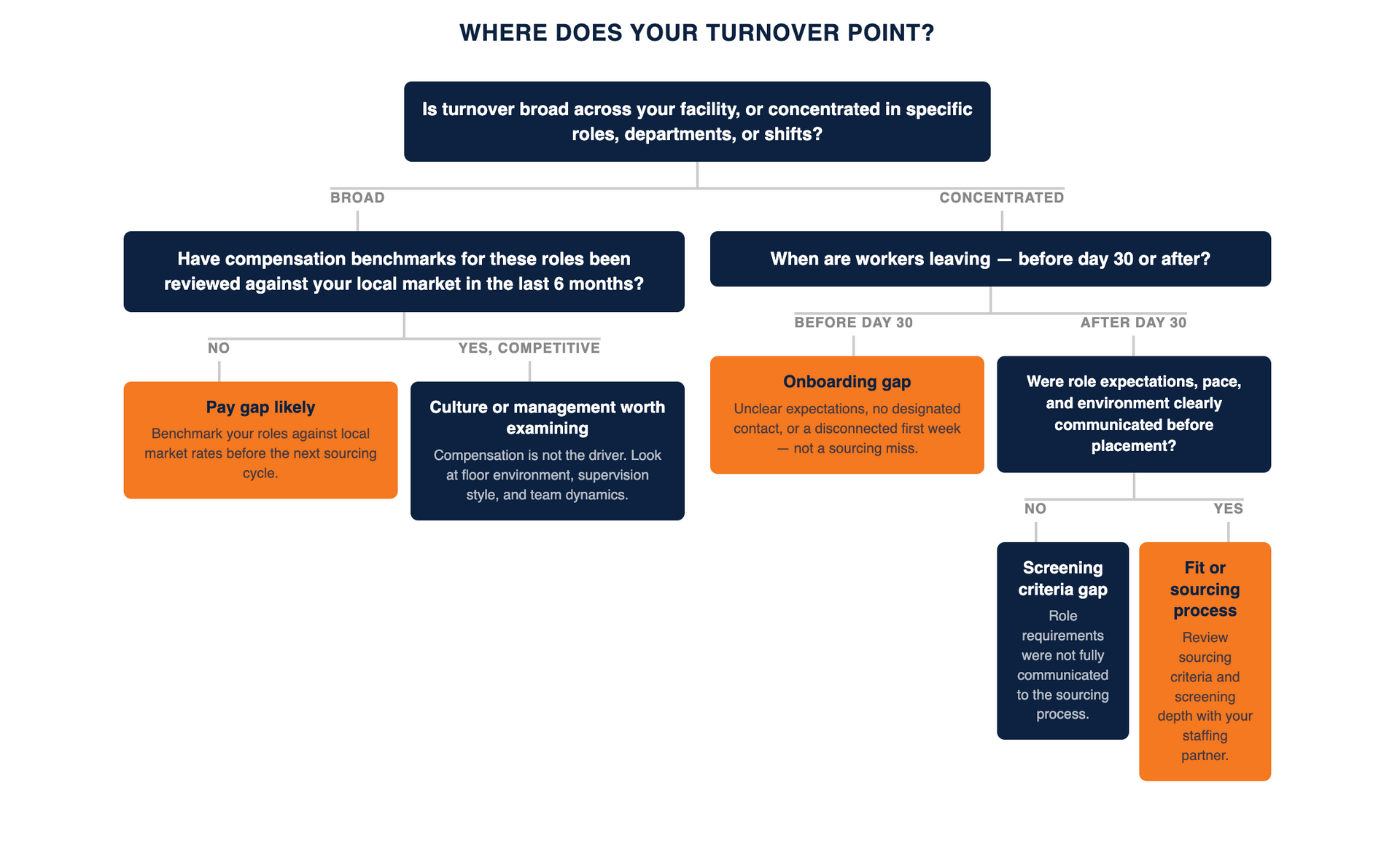
Before adding headcount, the flowchart below gives you a starting framework for reading your own pattern.
Why These Patterns Point Where They Do
Knowing which branch your turnover falls into matters less than understanding the mechanism behind it. That's what makes the next step targeted rather than another round of the same response.
Broad Turnover Usually Traces to Pay
When turnover is spread across roles, departments, and shifts rather than concentrated in one area, compensation is the most common driver. A pay rate that was competitive eighteen months ago may have fallen behind what nearby employers are offering for comparable work, and workers who have options will find that out faster than your internal data reflects it.
The clearest way to test this is to benchmark your current rates against what the local market is paying for the same roles before assuming the problem lies elsewhere.
Early Exits Point to Onboarding, Not Sourcing
A worker who leaves before day 30 rarely cites the role itself as the reason. The more common drivers are a first week that left expectations unclear, no designated person to answer questions, and a floor environment that signaled indifference before the worker had a chance to settle in.
Those are onboarding failures, not sourcing mismatches, and replacing the placement without changing the first-week structure produces the same outcome.
For a practical framework on what the first week should include, How to Onboard a Placed Worker So They Stay Past Day 30 covers the specific touchpoints that reduce early exits.
Late Exits Point to Fit or Screening Gaps
A worker who clears onboarding and stays through day 30 but leaves before day 90 usually points to a different problem.
The role fit looked adequate during sourcing but did not hold under actual working conditions, either because the screening process did not probe deeply enough for role-specific demands, or because the job order did not communicate those demands clearly enough for the recruiter to screen against.
Both are fixable, but they require a different conversation with your staffing partner than a sourcing volume request.

How to Act on What the Pattern Shows
Diagnosis without a next step just delays the same departure. Once you know the cause, the response should match it rather than default to sourcing faster.
A Low Show Rate Is a Screening Problem, Not a Sourcing Volume Problem
If placed workers are not showing up on day one, the instinct is to submit more candidates to increase the odds of a placement that sticks. That response treats a screening problem as a numbers game.
A low show rate almost always traces back to something in how candidates were vetted before submission, whether expectations about the role, the shift, or the commute were communicated clearly enough for the candidate to make an informed commitment.
Adding volume without fixing that step produces more of the same outcome at higher cost. Why Your Show Rate Is Low covers the specific screening gaps that drive show rate problems.
Fast Replacement Without Diagnosis Just Restarts the Cycle
Filling a vacancy quickly feels like progress. If the environment, the onboarding process, or the screening criteria that produced the last departure have not changed, the next placement enters the same conditions. The cycle restarts and the cost compounds.
The question worth asking before submitting a replacement order is whether anything about the role, the floor, or the sourcing process has changed since the last worker left.
If the answer is no, the placement is likely to produce the same result. High-Volume Hiring: Proven Strategies to Reduce Turnover Fast covers the tactical follow-through once the diagnosis is clear.
A Repeat Vacancy Triggers a Different Conversation, Not Another Job Order
When the same role opens a third time, submitting another placement order without pausing to examine the pattern is the most expensive response available. A third opening on the same role is a signal that something in the process, whether compensation benchmarking, onboarding structure, or screening criteria, needs to be examined before sourcing resumes.
That examination should happen before the next placement order goes in, not after the next worker leaves. For a closer look at what monitoring a placement looks like once sourcing is underway, What a Good Staffing Partner Looks Like at 90 Days covers the full framework.
If You Are Replacing the Same Positions Repeatedly, More Placements Are Not the Answer
Turnover that keeps coming back to the same roles is a process problem, not a labor market problem. Allied OneSource helps employers identify what is driving turnover at the process level, whether that is a compensation gap, an onboarding failure, or a screening mismatch, before recommending a sourcing solution. Let's start with a conversation about what you are seeing on your floor.
Reference
1. U.S. Bureau of Labor Statistics. "Table 4. Quits Levels and Rates by Industry and Region, Seasonally Adjusted." BLS, Job Openings and Labor Turnover Survey, June 2026, www.bls.gov/news.release/jolts.t04.htm.