
If your operation has cycled through more than one staffing vendor in the past two years without seeing better results, the instinct is to keep looking for a better vendor. The more likely explanation is that the two functions managing the relationship internally are not measuring it the same way.
Operations is watching whether shifts get covered and workers show up. HR is tracking cost per hire, contract compliance, and process documentation. Both are reasonable things to measure. When they are never reconciled into a shared standard, the staffing partner ends up receiving conflicting feedback from two directions and getting blamed for a problem that was set up before the first worker was placed.
Operations and HR Are Grading Staffing on Different Scorecards
Neither function is measuring staffing wrong. They are answering different questions, and those questions produce different verdicts on the same vendor at the same time.
Operations Measures Whether the Shift Gets Covered
For an operations director or a floor supervisor, staffing performance is immediate and physical. Did the worker show up on time? Is the shift covered? How long did it take to get a replacement when someone called out?
These are the questions that determine whether production runs, whether existing staff absorbs overtime, and whether a supervisor spends their shift managing a headcount gap instead of their actual job. Fill rate and show rate are not abstract metrics on the operations side of the building.
They are the difference between a shift that runs and one that doesn't, and the verdict on a staffing partner gets formed fast when those numbers slip.
HR Measures Whether the Process Holds Up
HR's staffing scorecard looks different. Cost per hire, contract compliance, invoice accuracy, and whether the vendor's documentation meets audit requirements are the metrics HR is accountable for. A placement that shows up and stays is a good outcome, but it has to clear a process filter first.
Gartner research found that only 9% of HR functions are both highly efficient and highly aligned with organizational needs.¹
In a staffing context, that gap tends to show up as an HR function optimizing for process compliance while operations is optimizing for shift coverage, with the staffing vendor caught between two sets of instructions that were never reconciled into a single standard.

You Can See the Disconnect at a Glance
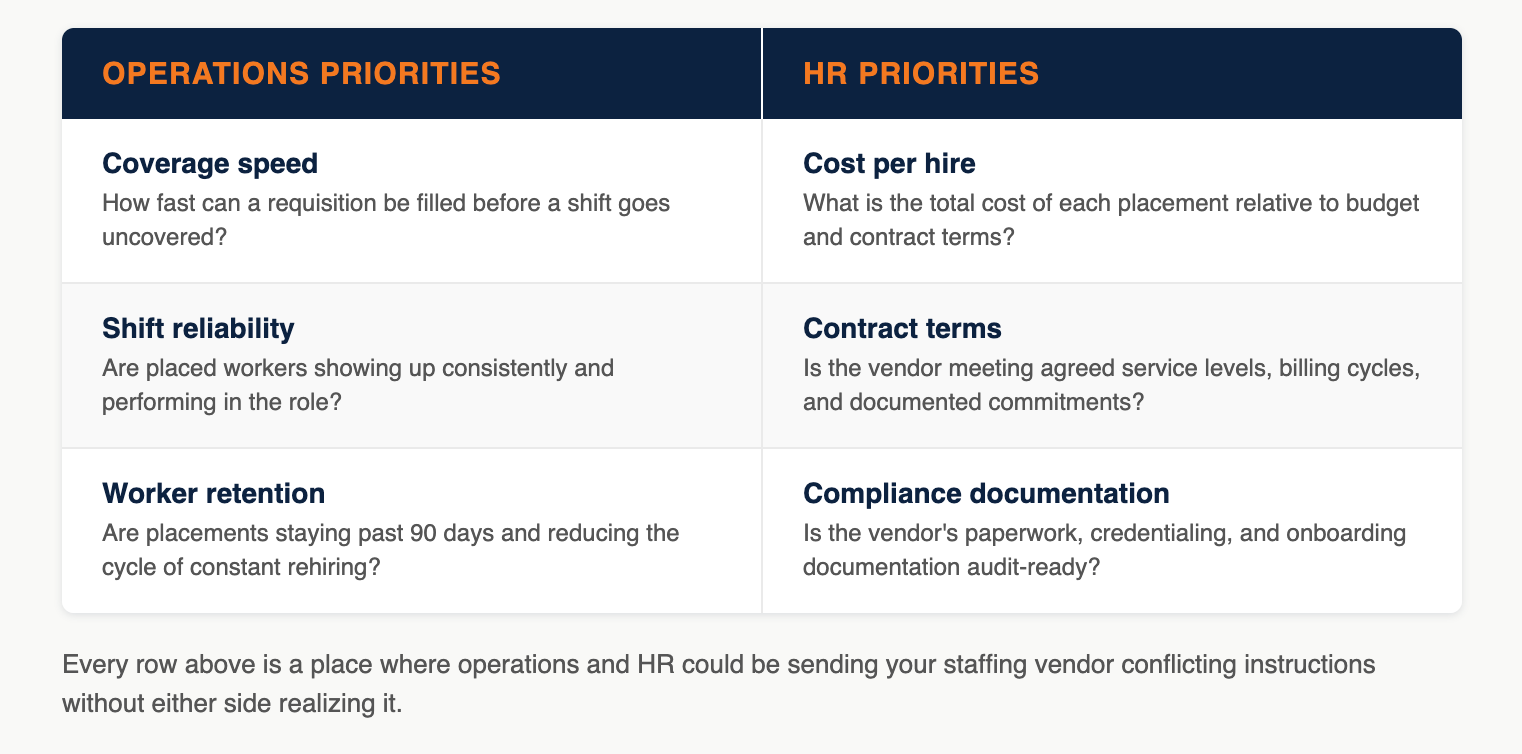
The table below maps the two scorecards side by side. Every row is a place where operations and HR could be sending your staffing vendor conflicting instructions without either side realizing it.
New Title
Fix the Internal Signal Before You Fix the Vendor
A vendor change does not resolve a measurement problem. Before the next contract conversation happens, the more productive question is whether operations and HR are working from the same definition of what good looks like.
Switching Vendors Does Not Fix a Measurement Problem
If operations and HR are sending conflicting performance signals, a new vendor inherits the same problem the previous one had. The fill rate complaints from the floor and the cost concerns from HR do not resolve because a different firm is now receiving them.
Switching changes the relationship without changing the conditions that made the prior relationship fail. Before you move to a new vendor, it is worth determining whether the problem is the vendor's process or the standard the vendor is being held to.
The Hidden Cost of Switching Staffing Partners breaks down what that cycle typically costs before a better outcome takes hold.
Aligned Metrics Have to Exist Before Placement, Not After
The window to align operations and HR on staffing performance expectations is before a vendor is selected and before the first worker is placed, not during a contract review when both sides are already frustrated. What fill rate is the vendor expected to hit? What show rate is acceptable? What does 90-day retention need to look like for the relationship to continue?
These are not complicated questions, but they need answers from both functions before a vendor can be held to them. A vendor evaluated against two different standards by two different internal stakeholders cannot consistently meet either one.
How to Evaluate a Staffing Partner Before You Sign covers how to build that standard before the conversation with a vendor begins.
A Strong Kickoff Includes Both Functions in the Room
Most staffing engagements begin with a single point of contact, and operations learns about the arrangement after the contract is signed. A stronger model brings both functions into the kickoff from the start, so fill rate targets, show rate expectations, and 90-day retention benchmarks are agreed upon before a single worker is placed.
Escalation paths get defined early so a missed shift reaches the right person immediately rather than surfacing in a quarterly review. For a closer look at what that standard should include once a partner is in place, What a Good Staffing Partner Looks Like at 90 Days covers the full monitoring framework.
Is Your Operations Team and Your HR Team Telling Different Stories About Your Staffing Partner?
That gap rarely stays contained to internal disagreement. It shows up in inconsistent feedback to your vendor, premature relationship changes, and staffing problems that repeat because the real source was never identified.
Allied OneSource builds the relationship across both functions from day one so that fill rate expectations, escalation paths, and performance metrics are agreed upon before a single worker is placed. Let's get everyone on the same page. Contact Us today!
References
1. Gartner. "Gartner Says Less Than 10% of HR Functions Are Achieving Functional Excellence." Gartner Newsroom, 13 Aug. 2023, www.gartner.com/en/newsroom/press-releases/08-14-2023-gartner-says-less-than-10--of-hr-functions-are-achiev.