
If you signed with a new staffing partner in the last few months, you probably have a general sense of whether things are going well, but not a specific set of markers that would tell you whether the relationship is performing. The first 90 days are when problems are cheapest to catch and least likely to get caught.
By the time a fill rate problem or a show rate gap becomes undeniable, a full quarter has passed, and switching costs are already in play. The 90-day window is when a staffing relationship either earns its place or quietly doesn't, and the difference between those two outcomes is usually visible well before day 90.
Catch a Problem Now or Pay for It at Renewal
A staffing relationship that is quietly underperforming looks identical to one that is working, until the evidence accumulates enough to be undeniable. By then, the cost of acting is higher than it would have been at week two.
Nobody Checks Until Something Breaks
The instinct in a new vendor relationship is to give it time. A ramp-up period is real, and flagging concerns too early can feel like setting a partner up to fail before they have had a chance to find their footing. That instinct is reasonable, but it creates a monitoring gap that compounds quietly.
Gallup found that only 12% of employees strongly agree their organization do a great job onboarding new hires, which illustrates how rarely organizations build proactive early monitoring into a new relationship even when the stakes are high.¹
The same gap shows up in staffing relationships, where the absence of a structured check-in cadence means the first signal of a problem is usually the problem itself, not a warning sign that preceded it.
What a Weak Partnership Looks Like Before It's Obvious
The early signals are not dramatic. A placed worker who shows up late in week one but stays through week three. A fill request that takes a day longer than expected but eventually gets filled. An account manager who responds but never initiates.
None of these is a clear failure on its own, and that is exactly what makes them easy to explain away individually. Together, they describe a relationship where the partner is reacting rather than managing, and that pattern tends to get more pronounced, not less, as the engagement continues.

What To Watch at Each Checkpoint
The signals are not complicated to track. What makes them useful is knowing which window each one belongs to, so a pattern gets caught when it is still cheap to address.
Weeks 1 to 2 — Find Out If the Firm Shares Data or Waits to Be Asked
The first two weeks tell you more about account management style than about placement quality. A staffing partner managing your engagement proactively will surface early data without being prompted: how many requisitions are open, how many candidates are in screening, what the expected submission timeline looks like.
A partner who waits for you to ask is demonstrating the cadence the relationship will run on going forward. Set the expectation in week one. Ask for a brief update on open requisitions and pipeline status.
How quickly that request is answered, and whether it prompts a standing check-in or a one-time response, tells you whether you have a partner who manages the relationship or one who services requests.
Day 30 — Check Whether Fill Rate and Show Rate Are Holding
By day 30 you have enough placements to read a pattern. Pull fill rate and show rate for every requisition submitted in the first month. If fill rate is below what your partner committed to, ask specifically what changed between submission and placement. If show rate is inconsistent, meaning placed workers are not showing up reliably on day one, the screening process is worth examining before the pattern extends into month two.
A first-month fill rate or show rate problem does not automatically mean the relationship is failing. It does mean the conversation needs to happen now, while the sample size is small enough to diagnose rather than large enough to argue about. For a closer look at what these metrics mean and how to read them, Staffing Fill Rate: The Metric That Tells You Everything covers the full picture.
Day 60 — Track How Fast Your Account Team Responds When Something Goes Wrong
By day 60 something will have gone wrong: a missed shift, a placement that did not work out, a requisition that stalled. That is not a failure; it is a normal part of any staffing engagement. What it reveals is how your account team handles an escalation.
A strong partner acknowledges the issue quickly, explains what happened, and tells you what changes in the process going forward. A weak one apologizes and moves on without addressing the underlying cause.
Response time matters, but it is not the only signal. An account manager who responds in an hour but offers no diagnosis is less useful than one who takes four hours and comes back with a specific answer. Track both speed and substance when something goes wrong at day 60.
Day 90 — Retention Is the Final Read on Whether the Process Worked
Ninety-day retention is the number that closes the loop on everything that happened before it. A placed worker who is still in the role at day 90 is the outcome that fill rate, show rate, screening quality, and account management were all building toward. If retention is holding, the process is working.
If workers placed in the first month are already gone, the issue traces back to something in the screening or sourcing process that the earlier checkpoints should have surfaced. Day 90 is not just a milestone to note.
It is the point where a pattern becomes a verdict, and where the case for staying with or switching from a staffing partner gets its clearest data. For employers weighing that decision,
The Hidden Cost of Switching Staffing Partners lays out what that choice actually costs.
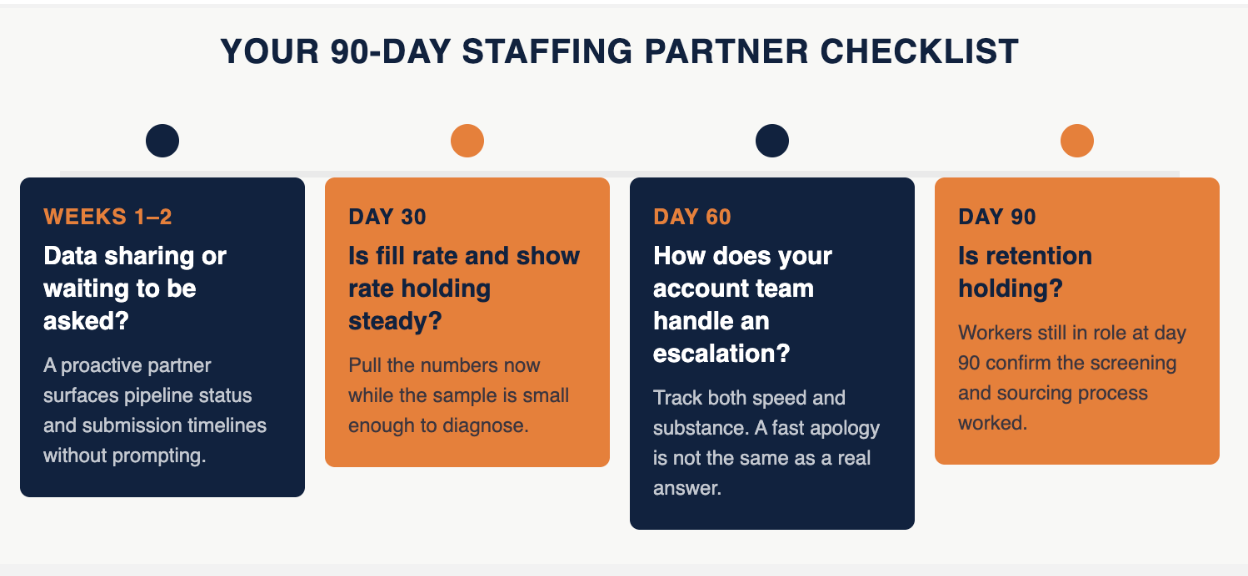
Your 90-Day Staffing Partner Checklist
Each checkpoint below maps directly to the signals worth tracking in that window.
Want a Staffing Partner With the Track Record to Back Up Day 90?
Allied OneSource Has Been Placing and Retaining Talent Since 1898.
Allied OneSource has filled roles across Skilled Trades, Manufacturing and Distribution, IT, Finance and Accounting, and more, which means the fill rate and retention benchmarks in this article are ones we've been held to for over a century. That experience is what shows up in your first 90 days, not just in the pitch. We've spent over a hundred years learning what makes a placement stick.
Connect with Allied OneSource to start your next 90 days off strong.
Reference
1. Gallup. "Why the Onboarding Experience Is Key for Retention." Gallup, www.gallup.com/workplace/235121/why-onboarding-experience-key-retention.aspx.