
Most Q4 staffing failures get blamed on the labor market, and the explanation feels plausible because the timing lines up: hiring gets harder right when volume peaks and the pressure to staff up is greatest. The more accurate explanation is that the decisions needed to handle Q4 volume were never made in September.
By the time October arrives and the orders land, your staffing partner is sourcing from a tighter candidate pool, compensation benchmarks have moved, and the lead time required to screen and place qualified workers has already been spent. The employers who handle Q4 well do not have better luck. They had a plan in place before the quarter started.
Q4 Staffing Problems Are Decision Problems
By the time October arrives, the decisions that determine whether your Q4 goes smoothly have already been due for weeks. The labor market does not suddenly become unworkable in Q4. What shifts is how much room you have left to respond when the decisions that should have been made in September are still sitting open.
Waiting Until October Means Negotiating Against a Tighter Market
Q4 is the structural seasonal high point for staffing demand, the period when temporary and contract staffing employment and sales peak after building through the prior three quarters.¹ Every employer in your vertical knows this, which means every employer who waited until October is competing for the same candidates at the same time.
The sourcing pool does not expand to meet that demand. Candidates who were available in September are placed by October, and the ones still available cost more or require longer lead times to screen and onboard. Waiting transfers leverage to the market at exactly the moment your operation can least afford it.
Lock In Headcount, Compensation, and Sourcing Timeline Before the Quarter Starts
How many workers you need and when determines whether your staffing partner has enough lead time to source and screen before volume arrives. What compensation you are willing to offer determines whether you are competitive in a market where every other employer is hiring at the same time.
What sourcing timeline you agree on with your staffing partner determines whether candidates are already in the pipeline when Q4 starts or still being recruited after it does. None of these is complicated to make in September, and all three become significantly harder once October is underway.

Three Decisions To Lock In Before Q4 Arrives
Each of the three decisions below has a natural deadline of mid-September. Miss that window and you are making the same decision in a more expensive market with less time to act on it.
Commit to a Headcount Number in September
The most common reason a staffing partner cannot deliver on Q4 volume is that the number arrived too late to source against. Sourcing, screening, and placing a qualified worker takes time, and that timeline does not compress cleanly under Q4 pressure.
If your staffing partner does not have a headcount commitment from you until October, they are starting a process in a tighter market that you could have started in a looser one.
The number does not need to be perfect. A working estimate with a reasonable range gives your partner enough to begin sourcing against while you finalize the details. Waiting for a precise figure before starting the conversation is itself a decision, one that costs you pipeline time you will want back in November.
Confirm Compensation Benchmarks Before the Market Moves
Compensation benchmarks for light industrial and manufacturing roles shift as Q4 demand builds. A pay rate that was competitive for your target roles in August may be below market by October, when every employer in your vertical is competing for the same candidates.
Confirming what the market is paying for your specific roles in September, and aligning your rate structure accordingly, keeps you competitive before the window closes rather than after.
Your staffing partner should be able to give you current benchmark data for your roles and region. If they cannot, that is useful information about whether they have the market depth to source effectively for you when Q4 pressure peaks.
Agree on a Sourcing Timeline With Your Staffing Partner
A sourcing timeline determines whether candidates are screened and ready before your Q4 volume lands or still in process after it does. It needs to account for sourcing lead time, screening steps, onboarding requirements, and any role-specific certifications before a worker can be placed productively.
The conversation your staffing partner needs in September cannot do the same work in October. For employers managing multiple vendor relationships heading into Q4, When to Consolidate Your Staffing Vendors covers whether simplifying that structure before the quarter hits makes sense for your operation.
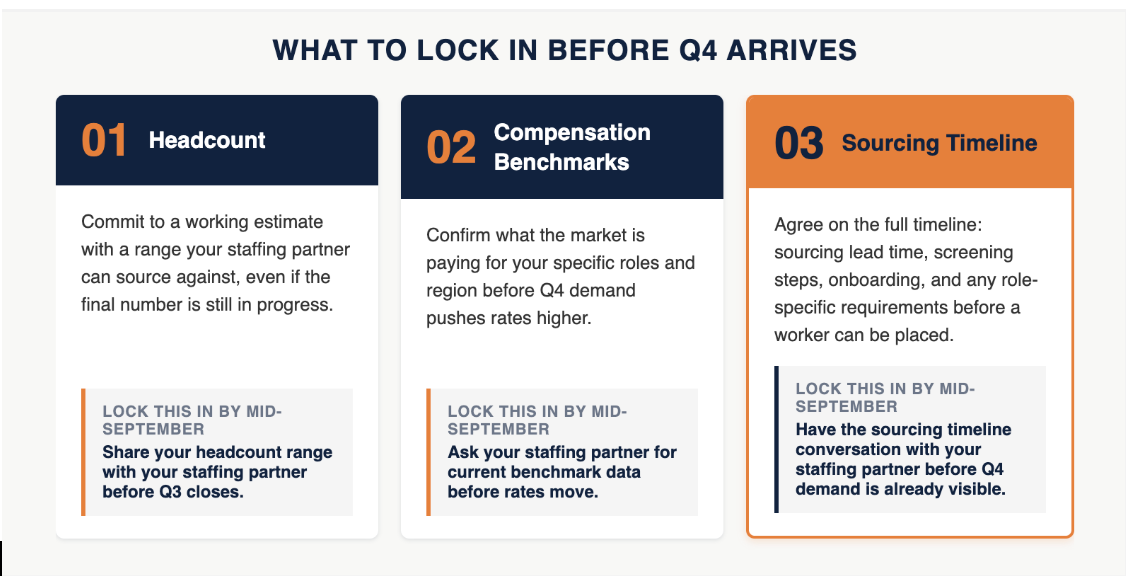
What to Lock In Before Q4 Arrives
The three decisions come down to three actions your operation can take before mid-September.
Q4 Is Closer Than It Feels Right Now.
Allied OneSource is already working with employers across light industrial, manufacturing, and skilled trades to lock in their Q4 headcount before the quarter arrives. Sourcing takes time, compensation benchmarks move, and the window to get ahead of peak demand closes faster than most employers expect. If you want candidates in the pipeline when the orders land, the conversation starts now.
Reference
1. American Staffing Association. "U.S. Staffing Industry's Seasonal Declines Narrow in First Quarter of 2026." PR Newswire, 25 June 2026, www.prnewswire.com/news-releases/us-staffing-industrys-seasonal-declines-narrow-in-first-quarter-of-2026-302810841.html.