When you are considering re-engaging a staffing agency after a gap, the conversation tends to run on memory. If the last relationship worked reasonably well, there is a pull toward picking up where things left off. If it did not, wariness fills the same role.
Neither instinct tells you what is actually true right now about the firm you are evaluating. A prior relationship is context, not a current performance read. The questions that give you that read are different from the ones most employers ask at re-engagement, and they are worth knowing before you sign anything.
Re-Engaging Isn't Continuing, It's Evaluating
A gap in a staffing relationship resets more than the calendar. It resets the information you actually have about how that firm performs today. Treating re-engagement as a continuation skips the evaluation that protects you from repeating what did not work the first time.
Familiarity Isn't the Same as Current Performance
You remember how the relationship worked, and that memory is doing more work in this decision than it should. A staffing partner you used three years ago earned that impression under different market conditions, with a different team, running a different process than whatever they're running today.
Treating that memory as current information is the same mistake as assuming a business hasn't changed just because you haven't been checking in on it. What you knew then tells you almost nothing about what's true now, and the only way to close that gap is to ask, not to assume.
A Staffing Firm Can Change Completely In A Year Or Two
Leadership priorities shift. The recruiters who knew your market may not still be there. Screening processes that felt thorough at the time may have been compressed or, the reverse, rebuilt into something more rigorous.
And some of what's changed is bigger than any of that. Staffing firms meaningfully using AI in their workflow saw significantly stronger revenue growth in 2025 than firms that didn't, and leaders confident in guiding that adoption were roughly 40 percent more likely to grow.¹
Only about one in ten firms report AI fully embedded across their process right now, which means the gap between a firm that's kept pace and one that hasn't is wide, and it's not something you'd see from the outside. None of that surfaces unless you ask.

The Questions That Actually Tell You Something
General reassurances about quality and speed are easy to give and hard to verify. The questions are harder to answer without current data, which is exactly what makes them worth asking.
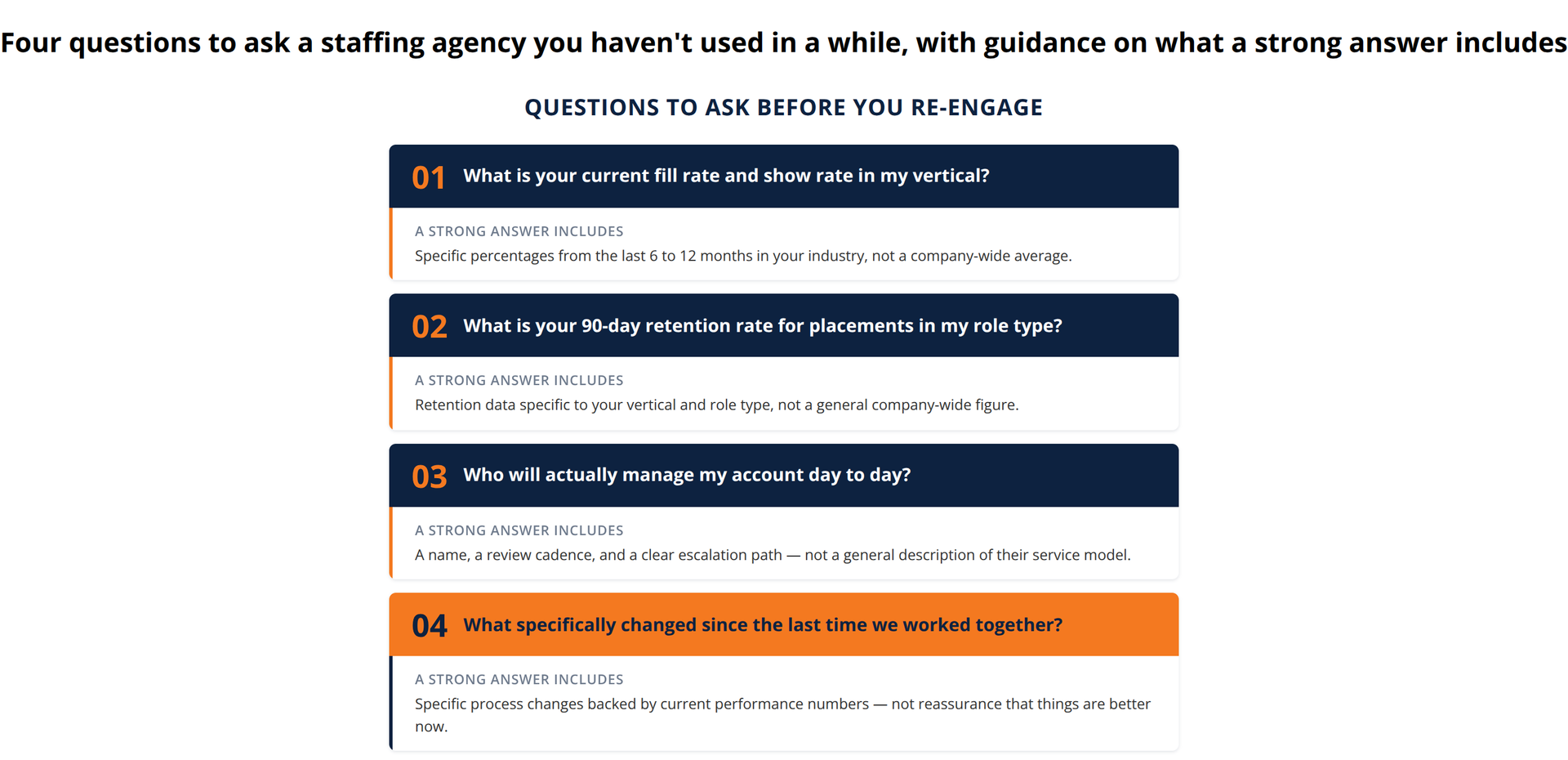
Ask for Current Fill Rate and Show Rate, Not Averages
Most staffing firms can produce an average fill rate across all clients and all time periods, and that number will look reasonable. What tells you something useful is their current fill rate for engagements in your vertical, over the last six to twelve months.
A firm performing well in light industrial placements right now will be able to give you that number without hesitation. One that cannot produce it, or deflects to a company-wide figure, is telling you something about how closely they track their own performance.
A strong answer sounds like: "Our fill rate for light industrial placements in the KC metro over the last twelve months is X%, and our show rate for the same period is Y%."
Ask for 90-Day Retention Data in Your Vertical
Company-wide retention figures smooth over the variation that matters most to you. A firm that places well in professional roles but struggles to hold light industrial placements past 60 days will not volunteer that distinction unprompted.
Asking for 90-day retention data specific to your vertical and role type forces the conversation to the level of granularity where performance differences actually show up. A strong answer sounds like: "In warehouse and distribution placements over the last year, our 90-day retention rate is X, and here is what our screening process looks like for those roles specifically."
Ask Who Will Actually Manage Your Account
The person who runs your sales conversation is rarely the person who manages your account day to day. Before you sign, ask directly: Who handles escalations? Who reviews fill rate and show rate with you? How often does that review happen?
A firm with a strong account management structure will answer that question with a name and a cadence. One that gives you a general description of their service model is telling you the answer is not yet determined.
A strong answer sounds like, "Your account manager is [name]; you will have a performance review every [cadence]; and escalations go directly to [name or role] within [timeframe]."
Ask What Specifically Changed Since You Left
A staffing partner that has genuinely improved since your last engagement will not answer this question with reassurances that things are better now. They will point to a specific process change, a rebuilt sourcing approach, or a new screening step, and back it with current numbers that reflect the improvement.
If a firm cannot answer that question specifically, the answer is that nothing has changed in a way they can measure, which is itself useful information before you commit to another contract. For a closer look at what evaluating a new partner looks like from the start, How to Evaluate a Staffing Partner Before You Sign covers the full framework.
It Has Been a While. Let's Make Sure the Fit Is Still Right.
Allied OneSource welcomes the hard questions about our process, our current numbers, and what has changed since your last engagement. If you are ready to have that conversation, we are ready too. Let's start fresh.
Reference
1. Bullhorn. "Bullhorn GRID Report: Staffing Firms Using AI See Stronger Growth, Faster Placements." Bullhorn, 25 Feb. 2026, www.bullhorn.com/news-and-press/press-releases/bullhorn-grid-report-staffing-firms-using-ai-see-stronger-growth-faster-placements/.