
Most employers evaluate a staffing agency by what the agency produces: how fast candidates come in, how well they match the role, how many show up on day one. What gets examined less often is what happens on your end of the handoff.
A staffing partner's ability to hit consistent fill rates depends directly on the quality of information, the speed of feedback, and the access it gets from you.
When those inputs are slow, incomplete, or inconsistent, the gap shows up in fill rates and no-show rates that get attributed to the agency. The starting point for better results is understanding what your side of the relationship actually requires.
Why You Struggle With Staffing Agencies
The friction that employers attribute to an agency's sourcing process or candidate quality often starts earlier, on the employer side of the handoff, before the agency has had a chance to act on it.
Slow Feedback Slows Everything Downstream
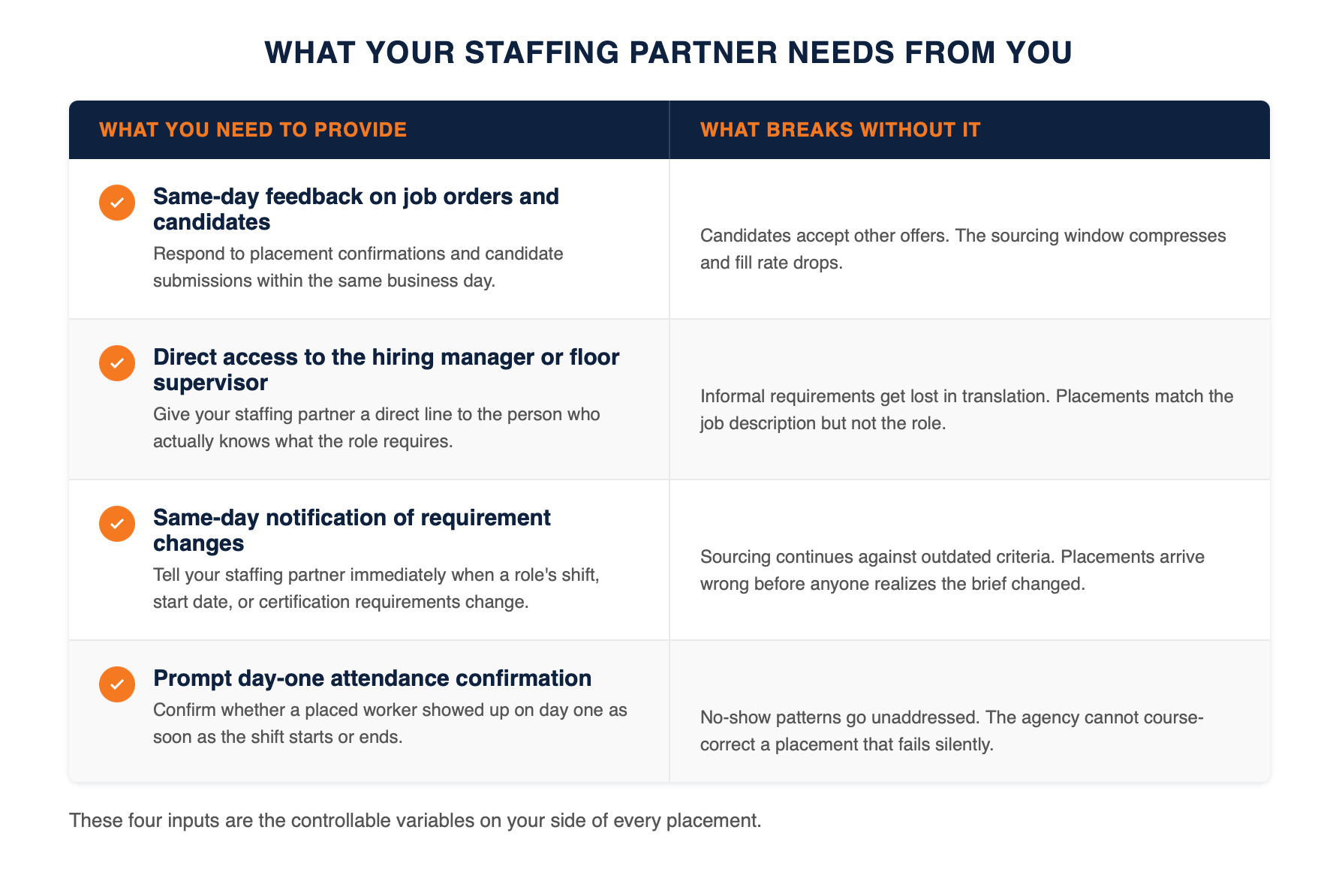
A staffing agency sources candidates against a job order and waits for feedback before the next step. When that feedback takes days instead of hours, the pipeline stalls. Candidates who were available on Monday accept other offers by Thursday.
Placement confirmation responses that arrive a day late create day-one attendance gaps that read as no-shows but trace back to a communication delay on the employer side.
SHRM's 2021 Talent Access benchmarking data puts the median time-to-fill for nonexecutive positions at 44 days.¹ That clock starts when a job order is submitted, but employer response time is a variable inside that window that the agency cannot control. Slow feedback does not just delay one placement. It compresses the sourcing window for every subsequent one.
Indirect Access Costs You Accuracy
When all communication between a staffing agency and a hiring manager routes through a single HR contact, something gets lost in translation at every pass. The floor supervisor who knows that the last three placements struggled with the pace of a particular line does not get to say that directly.
The recruiter who needs to understand what a shift actually looks like does not get to ask. What the agency receives instead is a cleaned-up version of the requirement that may not reflect what the role actually demands.
Direct access to the hiring manager or floor supervisor responsible for a role produces faster, more accurate placements. It also surfaces the informal requirements, schedule preferences, team dynamics, that never make it into a formal job order.
Requirement Changes That Don't Reach the Agency Get Sourced Against Old Criteria
A job order submitted on Monday reflects what the role required on Monday. If the shift structure changes, a certification becomes mandatory, or the start date moves, and the agency is not told immediately, sourcing continues against criteria that no longer apply. The placement that results is not a failure of the agency's process. It is a failure of the information flow between you and your partner.
Requirement changes happen in every operation. The variable is how quickly they reach the agency. A same-day communication closes the gap before candidates are screened against the wrong criteria. A delay of even two or three days can mean a full sourcing cycle runs against outdated requirements.

What It Takes to Get Consistent Results From a Staffing Partner
Consistent results require the right work at the right time, with responsibilities named before the gap shows up in fill rates.
Clear Job Orders Prevent Mismatched Placements
A job order that omits shift structure, physical requirements, or pace expectations gives a recruiter very little to screen against accurately.
The placements that result match the description but not the role, and early turnover gets attributed to candidate quality rather than to the information the agency was given. How to Write a Job Order That Gets You the Right Worker covers what a complete job order actually includes.
Performance Conversations Catch Small Gaps Before They Compound
A fill rate or show rate problem caught at week three is easier to diagnose and cheaper to fix than one that surfaces at a quarterly review. Naming a concern early gives your staffing partner something specific to respond to while the sample size is still small enough to act on.
How to Have a Performance Conversation With Your Staffing Partner covers how to structure that conversation so it produces a change rather than an apology.
What Your Staffing Partner Needs From You, and Why
The four inputs below are the controllable variables on your side of a placement. Each one pairs what the agency needs with what breaks downstream without it.
Allied OneSource Names Mutual Expectations Before Sourcing Starts
Allied OneSource defines responsibilities at the start of every engagement: what the employer commits to on feedback speed and hiring manager access, and what Allied OneSource commits to on fill rate, show rate, and 90-day retention.
Both sides work from the same definition of success from day one. For a closer look at what monitoring that looks like in practice, What a Good Staffing Partner Looks Like at 90 Days covers the full framework. Reach out to us today!
Reference
1. Society for Human Resource Management. "SHRM Benchmarking: Talent Access Report." SHRM, 2021, www.shrm.org/content/dam/en/shrm/executive-network/insights/Talent-Access-Report-TOTAL.pdf.