The short answer: Yes, apply when you meet the core of the job and can show it. Sort the posting into three piles: must-haves, skills you'd learn on the job and wish-list extras. Many jobs set a lower bar than you'd guess. In 2025, no prior work experience was required for 56.6% of U.S. civilian workers (BLS).
This guide is for job seekers in warehouse, production, office, professional and IT roles applying in a field they already know, not for career changers.
In this guide:
- Should You Apply If You Meet Only Some of the Requirements?
- Must-Haves, Learnables and Wish-List Lines: Sorting a Posting in Three Piles
- Which Gaps Actually Rule You Out?
- How to Present a Partial Match on Your Application
- Track Your Callbacks Against How Closely You Matched
- Frequently Asked Questions
- Apply for the Work You Can Do, and Show It
- References
In a 2022 SHRM survey, 36% of HR professionals said a high scorer on a skills assessment would very likely make the final list without the minimum years of experience (SHRM, 2022). So the minimum on a posting isn't always the minimum in practice. It's easy to read the list the other way: count the lines you can't check off and close the tab. The real question is which lines decide the job.
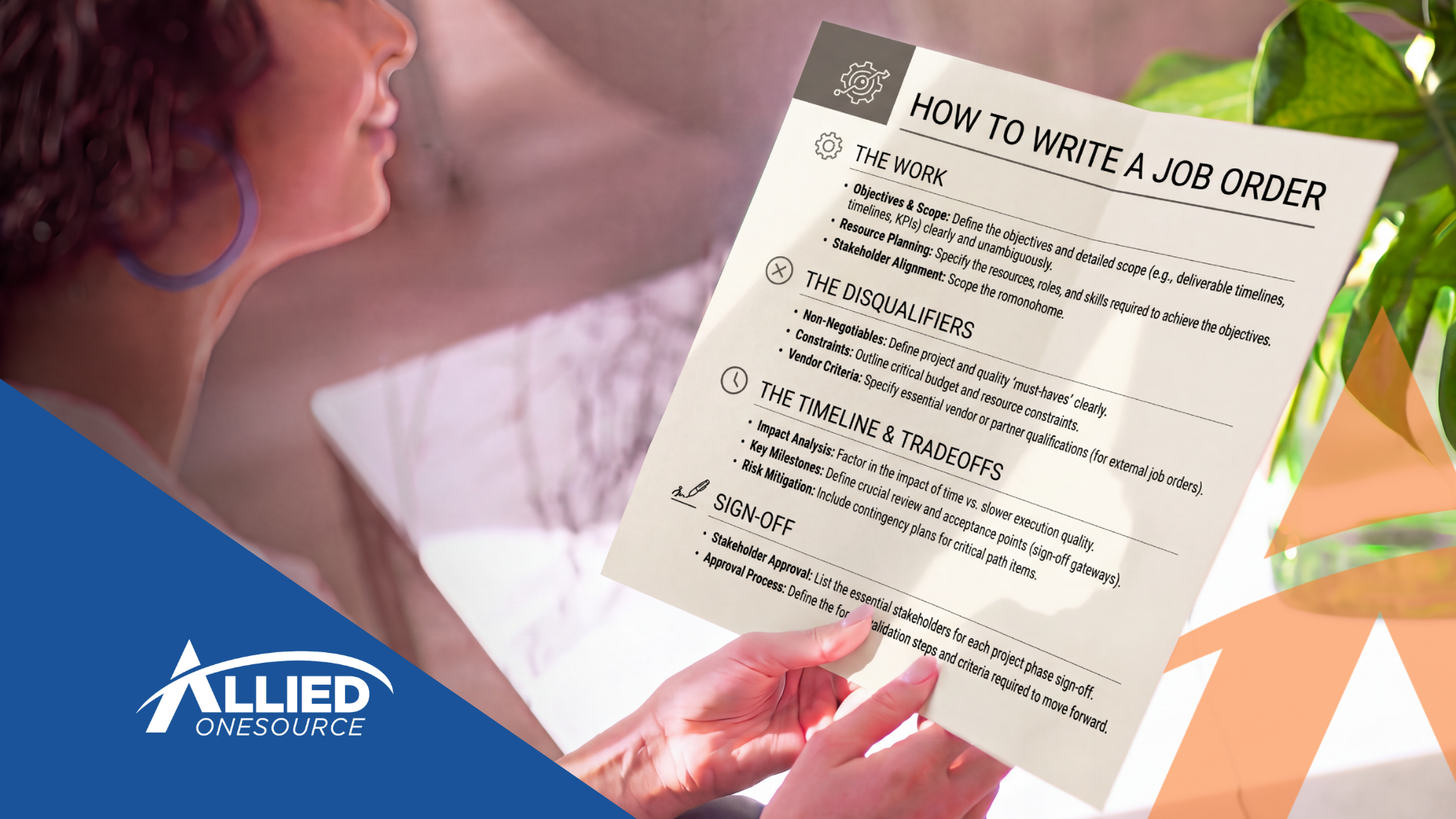
We see both sides of a posting at Allied OneSource: the employer's order and the candidate's resume. Our guide for employers on writing a job order asks them to say what experience is actually required versus preferred, because a title and a start date don't tell a recruiter either one. A posting doesn't always print that split, so you have to find it yourself.
This guide covers whether to apply on a partial match and how to sort a posting into three piles. It then covers which gaps really rule you out, how to present a partial match and what to track, with notes from Allied OneSource's own recruiting process.
Should You Apply If You Meet Only Some of the Requirements?
Yes, if you meet the requirements the work depends on and can prove them on the page. Employers expect to train new people. In 2025, on-the-job training was required for 80.6% of U.S. civilian workers (BLS, 2026). A line naming something you'd learn once you start describes that training. It doesn't rule you out.
Postings get written before anyone has met you. A hiring manager often lists what they'd love to see and HR adds the standard lines, so the result often describes an ideal hire rather than a row of locked gates. The formal floor is lower than a lot of postings read: in 2025, 32.5% of civilian workers had no minimum education requirement, and a high school diploma was required for 39.3% (BLS, 2026). Read every degree line twice.
Experience requirements are just as uneven. At least 90% of workers in 26 occupations needed no prior work experience in 2025 (BLS, 2026). Stockers and order fillers were at 93.0%, and hand packers and packagers at 97.6% (BLS, 2026). The firm lines sit higher up: in 10 occupations, all management and supervisor roles, more than 99% of workers needed experience (BLS, 2026). Experience gates rise with the job.
Don't count on a generous reader, though. A 2024 study by Harvard Business School and the Burning Glass Institute looked at firms that announced they'd dropped degree requirements (Harvard Project on Workforce, 2024). The change reached fewer than 1 in 700 hires in 2023, and about 45% of those firms changed their postings in name only (Harvard Project on Workforce, 2024). Among firms that followed through, workers without degrees hired into formerly degree-required roles were retained at a rate 10 percentage points higher than their degree-holding colleagues (Harvard Project on Workforce, 2024). A softer posting isn't a softer screen. Your application still has to show the match.
Must-Haves, Learnables and Wish-List Lines: Sorting a Posting in Three Piles
Sort every line of a posting into three piles before you decide: must-haves, learnables the employer will teach and wish-list extras. Licensing is the clearest must-have. In 2025, 22.9% of civilian workers needed a license or certification (BLS, 2026). Many of the other lines on a posting deserve a second look.
1. Read the duties before the requirements
The detail most job seekers skip is the duties list, because requirements describe a person while duties describe the work. If you've done most of the duties, even under a different job title, you meet the core of the job. Mark each duty you've done in the last few years and note where you did it. That list is your proof.
2. Sort each requirement line
Then go line by line. A line is a must-have when the law, safety or the core duty depends on it, such as a license, a certification the job names, a background check or the shift itself. A line is a learnable when it names a system, a process or a tool the employer uses, since employers expect to teach their own setup. Words such as "preferred," "a plus" and "ideally" usually mark a wish-list line. Once you know which lines matter, our keyword guide shows how to mirror the posting's own wording.
3. Count only the must-haves you can prove
Count the first pile and nothing else, and if you meet every must-have and most of the duties, apply. If you're missing one must-have, check whether you could close it before a start date. If you're missing two or more, keep looking or ask. On our side, a candidate uploads a resume and has a quick consultation with a recruiter, then takes a skills assessment as the profile is built, as our job seeker process lays out. The consultation is where your goals and strengths come up.
In SHRM's 2022 survey, 28% of HR pros would very likely shortlist a top assessment scorer lacking the minimum education. Proof beats the checklist. Mark each must-have on your next posting with proof. Want our recruiters' read? Send us your resume
Which Gaps Actually Rule You Out?
A gap rules you out when the employer can't legally or safely let you do the work without it. Credentials beyond a license are rarer than they look. In 2025, 6.5% of civilian workers needed an educational certificate and 1.2% needed an apprenticeship (BLS, 2026). Years, systems and degree wording are where postings have room.
The table below sorts the gaps job seekers worry about most by whether they usually end an application.
| The gap | Does it usually rule you out? | Why | What to do |
|---|---|---|---|
| Forklift operator certification | Not if you can be evaluated | The employer trains, evaluates and certifies each operator | List the trucks you've driven |
| A license the job names | Yes | The work can't legally start without it | Apply once it's issued or scheduled |
| A shift, schedule or lifting demand | Yes, if you can't meet it | It's the job itself | Say so early |
| Years of experience | Often not | Minimums give way for strong candidates | Show the duties you've done |
| A specific software or system | Rarely | Employers teach their own setup | Name the closest system you've used |
Forklift work shows how a must-have can still be partly learnable. OSHA permits only trained and competent operators to drive a powered industrial truck (OSHA). The employer must certify that each operator has been trained and evaluated, and prior training counts when it fits the truck and the operator is found competent (OSHA). Operators are re-evaluated at least once every three years, so a recent evaluation on a similar truck is worth naming (OSHA). Tell them what you've driven.
The lines that hold are the ones tied to law, safety or the hours. A shift you can't work won't change because your resume is strong, and a missing license can't be trained away on site. Everything else is a conversation.
The move most job seekers miss: answer the gap before anyone asks. Put a line in your summary such as "Trained on sit-down counterbalance trucks, ready for site evaluation," and it turns a missing certificate into a question the employer can settle in a day. Our guide to warehouse job interviews covers having certifications and screening paperwork ready before you walk in.
How to Present a Partial Match on Your Application
Present a partial match in three moves: lead with the duties you've done, name each gap once with your closest proof and ask when a line isn't clear. U.S. job openings stood at 7.1 million in August 2026 (BLS JOLTS, 2026). You need only one of them.
- Lead with the duties you've done. Put the two or three duties that match the posting at the top of your resume, in the posting's own words.
- Name the gap once, with your closest proof. Write one sentence in your summary or cover note that says what you've done that comes nearest and what you're doing about the rest. Skip the apology, because a plain gap reads as a fact and an apology reads as doubt.
- Ask before you rule yourself out. When you can't tell whether a line is firm, ask someone who knows the order. A recruiter can screen openings with you before you spend an evening on an application.
Let a tool handle the timing and a person handle the questions. Set job alerts so new postings reach you the day they open, and keep the conversation about a gap with a person who can answer it. A form can't tell you which line the employer will bend on.
If a posting has one must-have you can't prove on paper, that line likely decides the application, not the other nine. Unless it's a license, write the sentence that shows your closest experience. Still stuck? Want our roles matched to your skills? Register with us
Track Your Callbacks Against How Closely You Matched
Track three numbers for each application: the must-haves listed, the must-haves you proved on the page and whether you heard back. Many employers test as well, and in a 2022 SHRM survey, 56% used pre-employment assessments (SHRM, 2022). Ten applications give you a rough pattern.
Set the baseline before you change anything. Rebuild your last few applications from the postings you saved, then log every new one on the day you send it, along with the posting itself. Without that starting point, you can't tell a better approach from a busier month.
Then read the numbers together. If you hear back when you proved every must-have but not otherwise, your sorting is right and your gap sentences need work. If you aren't hearing back even on full matches, suspect presentation first: the wording, the format or a missed instruction. Some silences have nothing to do with you, such as a role filled before your application was read. If you get interviews and stall there, the screen is working and the conversation needs practice. Our rundown of common application mistakes helps with the second case.
Frequently Asked Questions
What does "preferred qualifications" mean on a job posting?
Preferred qualifications describe what an employer would like in an ideal hire. They aren't the minimum it will consider. Required or minimum qualifications are the floor. Meet the required lines and some preferred ones, and you're inside the range the employer is hiring from.
What counts as equivalent experience on a job application?
Equivalent experience is work that taught you what the listed degree or credential is meant to prove. It usually means years doing the same duties, often in a related role. Spell out the duties and the time so the employer doesn't have to guess.
Do online applications screen you out automatically for a missing requirement?
Some do. An online application can ask yes-or-no questions about a requirement, and an employer can set a "no" to end it there. Answer honestly. If the form offers a text box, use it to name your closest experience.
Why do I keep getting rejected when I meet most of the requirements?
There are three usual reasons: a must-have you didn't prove, wording that doesn't match the posting, or rivals who matched every line. The first two are fixable on your next application. Check that your resume proves every firm requirement in the posting's own words.
Can a staffing agency help if I don't meet every requirement?
Yes. A staffing recruiter can ask the employer which requirements are firm for a given order. They can also put you forward for roles you might have skipped. At Allied OneSource, it starts with your resume and a quick consultation with a recruiter.
Apply for the Work You Can Do, and Show It
A job posting describes the hire an employer hopes for. The people who get hired are the ones who show the core of it. They sort the posting before deciding, prove every must-have on the page, name each gap once and ask when a line's status is unclear. None of that takes long.
If you've been closing tabs on jobs you could do, start with the last posting you skipped: sort it, count the must-haves and see what was really in the way. You bring the experience and the honest sentence about the gap. Our recruiters bring the read on our own open orders, and it's our job to take your resume to the right people. When you're ready, browse our open roles.
References
- "Using Skills Assessments Over Education, Experience Requirements." SHRM (survey of 1,688 SHRM members, February 2022). Published August 31, 2022. Verified live 2026-10-19.
- "Occupational Requirements Survey: All Civilian Workers." U.S. Bureau of Labor Statistics (2025 reference year). Published January 16, 2026. Verified live 2026-10-19.
- "No prior work experience required for 90 percent of workers across 26 occupations in 2025." U.S. Bureau of Labor Statistics, The Economics Daily (Occupational Requirements Survey). Published September 30, 2026. Verified live 2026-10-19.
- "Skills-Based Hiring: The Long Road from Pronouncements to Practice." Project on Workforce, Harvard Kennedy School (Joseph Fuller; summarizing the Burning Glass Institute and Harvard Business School report by Sigelman, Fuller and Martin). Published February 14, 2024. Verified live 2026-10-19.
- "Occupational Requirements Survey: Credentials." U.S. Bureau of Labor Statistics (2025 reference year). Published January 16, 2026. Verified live 2026-10-19.
- "Powered Industrial Trucks eTool: Training." Occupational Safety and Health Administration (29 CFR 1910.178(l)). Published undated. Verified live 2026-10-19.
- "Job Openings and Labor Turnover Summary, August 2026." U.S. Bureau of Labor Statistics (seasonally adjusted; August 2026 preliminary). Published September 29, 2026. Verified live 2026-10-19.