
When a placed worker quits in the first two weeks, the instinct is to send the placement back to the staffing firm as a sourcing failure. In many cases, the sourcing was fine. What failed was what happened on the floor after the worker arrived.
Placed workers who leave early most often cite the same reasons: unclear expectations about the shift, no one designated to answer questions, and a first few days that felt more like being left to figure it out than being brought into the operation. Those are not sourcing problems. They are onboarding problems, and they are on your side of the handoff to fix.
What's Really Behind Early Turnover
The reasons placed workers leave in the first 30 days are rarely about the role itself. They trace back to specific gaps in the first few days that compound before anyone on the floor realizes a departure decision is already forming.
Gallup found that only 12% of employees strongly agree their organization does a great job onboarding new hires.¹ For a placed worker, the margin for a weak first week is even thinner than it is for a direct hire.
A direct hire has applied, interviewed, and chosen the role, which buys some institutional patience when the first few days are rocky. A placed worker arrives with less of that buffer, and a disorganized or unwelcoming first week reads as a signal about the job itself, not just the onboarding process.
Unclear Shift Expectations Create Doubt on Day One
A placed worker who shows up on day one without a clear picture of their shift structure, break schedule, safety requirements, or performance expectations spends the first hours filling in gaps with assumptions. Some of those assumptions will be wrong. When they are corrected mid-shift or not corrected at all, the worker's confidence in the placement erodes fast.
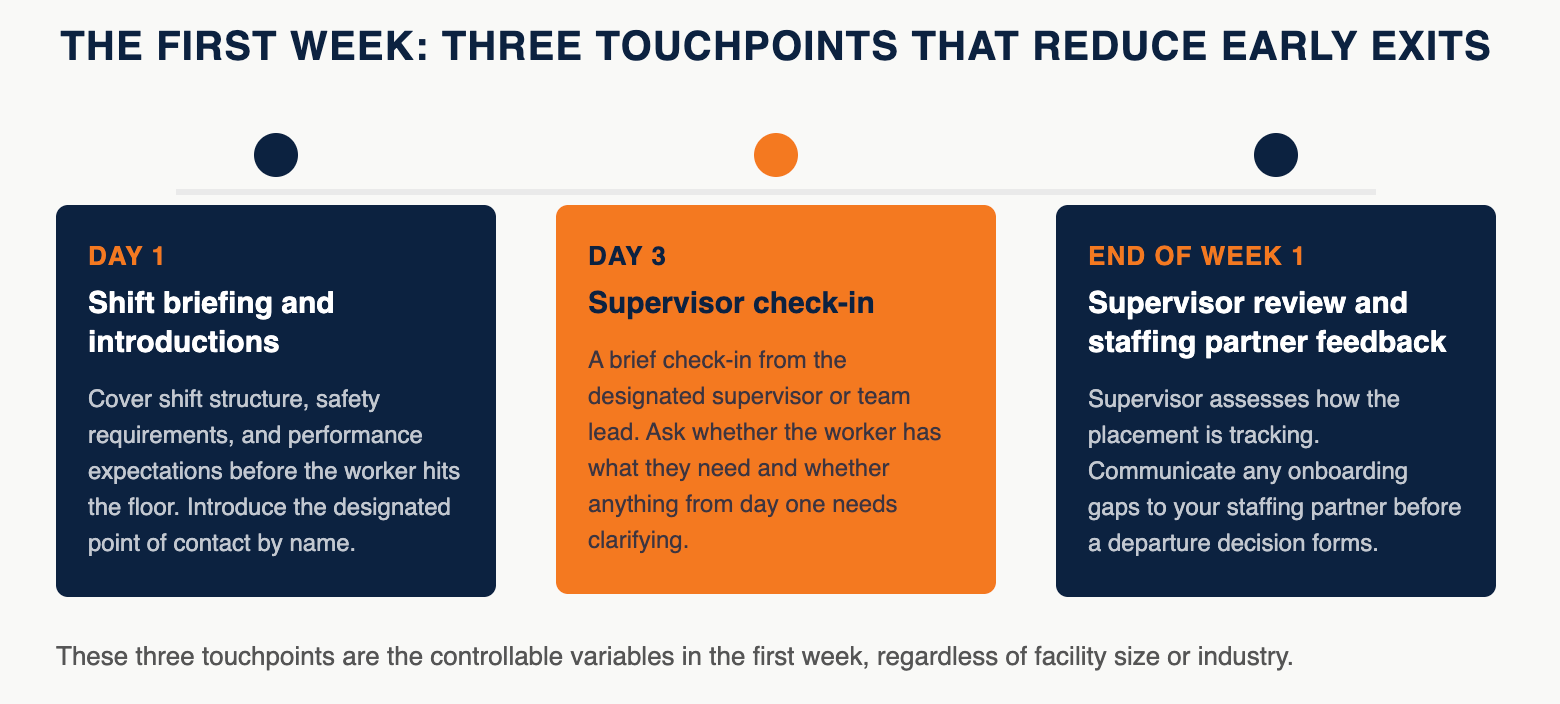
A five-minute shift briefing before the worker hits the floor resolves most of this. The briefing does not need to be formal. It needs to cover what the shift looks like, what is expected, and who to go to with questions.
No Designated Point of Contact Leaves Questions Unanswered
A placed worker with a question on day two who cannot identify who to ask will either guess, make a mistake, or disengage. None of those outcomes serves your operation. Designating a specific supervisor or team lead as the point of contact for the placed worker in the first week costs nothing and removes the most common source of first-week friction.
The contact does not need to manage the worker full time. They need to be identifiable, accessible, and willing to answer a question when one comes up.
Feeling Unwelcome on the Floor Compounds Fast
A placed worker who is not introduced to the team, given a workspace, or acknowledged beyond the minimum required to get them started will register that signal before the first shift ends. It does not take a hostile environment to produce an early exit. Indifference is enough.
A brief team introduction, a clear workspace setup, and one check-in from a supervisor before the end of day one are the difference between a worker who comes back on day two and one who does not.

What It Takes to Keep a Placement Past Day 30
The first-week framework gets a placed worker to day seven. What keeps them past day 30 is follow-through on both sides of the relationship, yours and your staffing partner's.
If Early Turnover Is a Pattern, Not a One-Off
A single early exit can be a sourcing miss, a poor fit, or a personal circumstance outside anyone's control. When early turnover happens repeatedly across multiple placements, it signals something structural, either in how roles are being sourced, how workers are being onboarded, or both.
That pattern is worth diagnosing before the next placement cycle begins. For operations dealing with recurring turnover beyond the first-30-days scope, What High Turnover in Your Facility Is Actually Telling You covers the broader diagnostic framework.
Feedback to Your Staffing Partner Closes the Loop
A placed worker who is struggling at the end of week one is not yet a departure, but they are close to one. Communicating what you are seeing to your staffing partner at that point, attendance patterns, attitude on the floor, questions that keep coming up, gives the firm something specific to act on.
Your staffing partner can follow up directly with the worker, address a concern before it compounds, or flag that the placement may need to be reconsidered before day 30. That intervention only happens if the information reaches the agency while there is still time to use it.
What the First Wek Should Look Like
The three touchpoints below are the controllable variables in the first week, regardless of facility size or industry.
Allied OneSource Follows Up in the First Week to Catch Gaps Early
Allied OneSource does not wait for an end-of-week report to find out how a placement is tracking. A follow-up with the employer happens in the first week of every engagement to surface onboarding gaps before they become a departure decision.
If a placed worker is unclear on expectations, disconnected from the team, or showing early signs of disengagement, that conversation happens while there is still room to course-correct. For placements that are not working out despite a structured first week, What to Do When a Placed Worker Is Not the Right Fit covers how to handle that conversation with your staffing partner.
Reference
Gallup. "Why the Onboarding Experience Is Key for Retention." Gallup, www.gallup.com/workplace/235121/why-onboarding-experience-key-retention.aspx.