You extend an offer, the worker accepts, and you build your schedule around them showing up. Then day one arrives and they don't. Show rate is the percentage of placed workers who actually appear for their first shift, and when that number sits below where it should be, most managers look at the same place first: the people you hired.
If your candidates are unreliable, the thinking goes, a stronger applicant pool should fix it. But the workers who accepted the offer are also the ones who didn't show, which means the pool was never really the variable. Something happened in between.
Why the Candidate Pool Gets Blamed
When show rates are low, blaming the candidate pool is the reasonable conclusion. Fewer people are actively looking for work in some markets, and the ones who are available do not always follow through the way they used to. That explanation feels fair because it matches what you are seeing on your floor: offers accepted, then nobody there on day one.
The problem is where that explanation points. It puts the cause outside your control and outside your staffing partner's control, which means nothing about the process changes. You just wait for a better batch of candidates and hope the next round holds up.
But the window between offer acceptance and day one is where show rate actually gets decided, and that window belongs to a process, not to the labor market. What happens inside it is where the real answer lives.
Where the Breakdown Actually Happens
Show rate does not fail at one single point. It fails in stages, starting well before a worker ever accepts a placement and continuing all the way until they either show up on day one or don't. Each stage below is a place where the process can hold or give way.
Reliability Indicators Don't Surface in a Standard Skills Screen
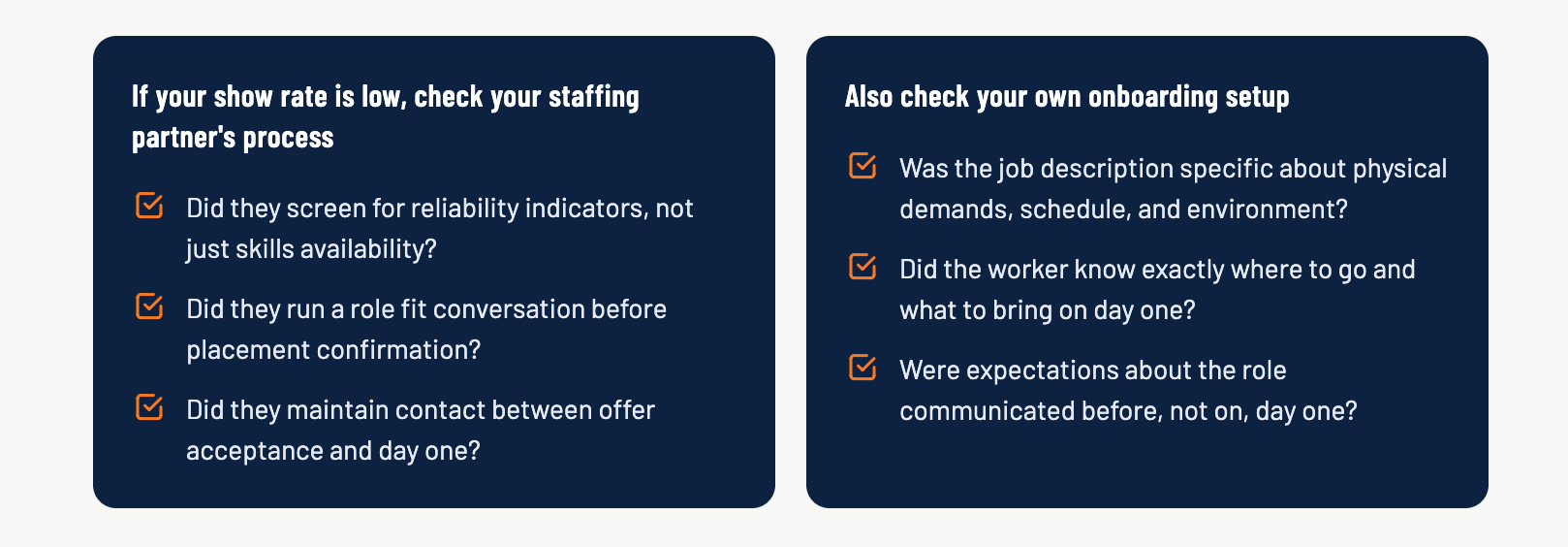
A skills screen tells you whether a candidate can do the job. It does not tell you whether they will show up to do it. When a screening process prioritizes availability and basic qualifications over reliability signals and follow-through history, it produces placements that look solid on paper and then disappear between offer and day one.
The candidate passed every check that mattered to the screen. None of those checks were built to catch the thing that actually determines show rate.
That gap is not a small oversight. It means show rate is already being decided before a single placement confirmation goes out, based on what the screen was never designed to measure.
Offer Acceptance Without Role Clarity Gives Workers Time to Reconsider
A candidate who accepts an offer without a clear picture of the role's physical demands, schedule, commute, or day-to-day environment is accepting in the abstract. They know the title and the pay. They do not yet know what the job will actually feel like once they are in it. That gap leaves room for doubt to grow in the days between acceptance and the first shift.
A specific, honest role-fit conversation closes that gap before it opens. It is what turns an offer acceptance into an actual commitment instead of a placeholder decision the worker is still quietly reconsidering. Without it, the worker spends the offer window answering their own questions about the role, and not always in the direction of showing up.
Silence Between Offer and Day One Produces Doubt, Not Readiness
If your firm sends a placement confirmation and considers the job done leaves the worker without contact during the window that most determines whether they show up. No follow-up means the worker is filling that silence on their own; revisiting the decision, comparing the role against other options that came in after they accepted, and developing doubts that a single check-in call would have addressed.
Leaving placed workers with no communication between offer acceptance and day one leads to disengagement before they even start: candidates use that silence to question their fit, and it leaves the door open for competing offers to move in.¹
Your Onboarding Setup Might Be Part of It Too
Not every show rate problem belongs to the staffing firm. If a placed worker accepted an offer without knowing exactly where to report, what to bring, what day one looks like, or what the physical demands of the role actually are, the show rate gap has an employer-side cause that switching vendors won't resolve.
Gallup found that only 47% of employees strongly agree that they know what is expected of them at work, highlighting how common clarity gaps are in the workplace.² When that clarity gap starts at the offer stage rather than after day one, it gives workers a reason to reconsider before they ever arrive. Before concluding the problem is your staffing partner, check whether your own pre-day-one communication gives a placed worker a clear, specific picture of what they are walking into.
What a Partner Who Tracks Show Rate Actually Does Differently
Most staffing firms don't track show rate as an internal performance metric. Without that number, there is no systematic way to know whether the placement-to-day-one process is working or failing, which means the same gaps repeat across accounts without anyone identifying the pattern.
Allied OneSource tracks show rate across every engagement and maintains pre-start contact with every placed worker between offer acceptance and day one. That contact is not an administrative step. It is what keeps the offer-to-day-one window from becoming the place where your next show rate problem starts. Contact us today to find out more.
References
1. "Employers Risk Driving New Hires Away with Poor Onboarding." SHRM, 21 Dec. 2023, www.shrm.org/topics-tools/news/talent-acquisition/employers-risk-driving-new-hires-away-poor-onboarding.
2. Gallup. "3 Employee Engagement Strategies for 2026."
Gallup, 26 Mar. 2026,
www.gallup.com/workplace/703361/employee-engagement-strategies-2026.aspx.