Your Q3 production surge is coming, and manufacturers across the Kansas City metro will be competing for the same limited labor pool. Manufacturing in the region is outperforming the national economy right now,¹ increasing demand for skilled workers just as production needs rise.
You already know how it goes: hiring accelerates, competition intensifies, and every open shift becomes harder to fill.
Orders spike, you fill headcount fast enough to keep pace, and Q4 arrives with half of those workers gone, not because the surge ended but because the people you hired for speed were never screened for what came after it. The problem isn't finding enough workers for Q3. It's finding workers who are still on your line when Q4 demand hits and the applicant pool has thinned out again.
Why Fast Staffing Creates a Second Vacancy Wave
Speed and screening pull against each other, and most production surges get planned around the wrong one.
When a staffing partner sources purely for availability, the goal becomes filling the shift, not filling it with someone who wants to stay past it. That distinction matters more than it looks like on paper. Temporary and contract turnover across the staffing industry sits at 376 percent, an improvement from 416 percent the year before, but still a figure that reflects how loosely most surge hiring gets screened.²
Your production floor absorbs that same pattern. A worker placed with no assessment of role fit or long-term interest treats the assignment as exactly that, an assignment, and leaves the moment volume levels off. That's usually right around when Q4 begins.
The vacancy you thought you solved in Q3 reopens itself in Q4, except now you're hiring into a thinner applicant pool with less lead time than you had the first time around.
Plan Production Surge Headcount Without Creating a Q4 Problem
Fixing the timing problem starts before you ever post a role, and it starts further back than most operations plan for.
The Six - to Eight-Week Lead Time Is Non-Negotiable
Median time-to-fill across industries already runs close to a month and a half.3 That's the baseline speed of hiring when nothing is rushed. A production surge compresses that timeline instead of expanding it, which is exactly backward.
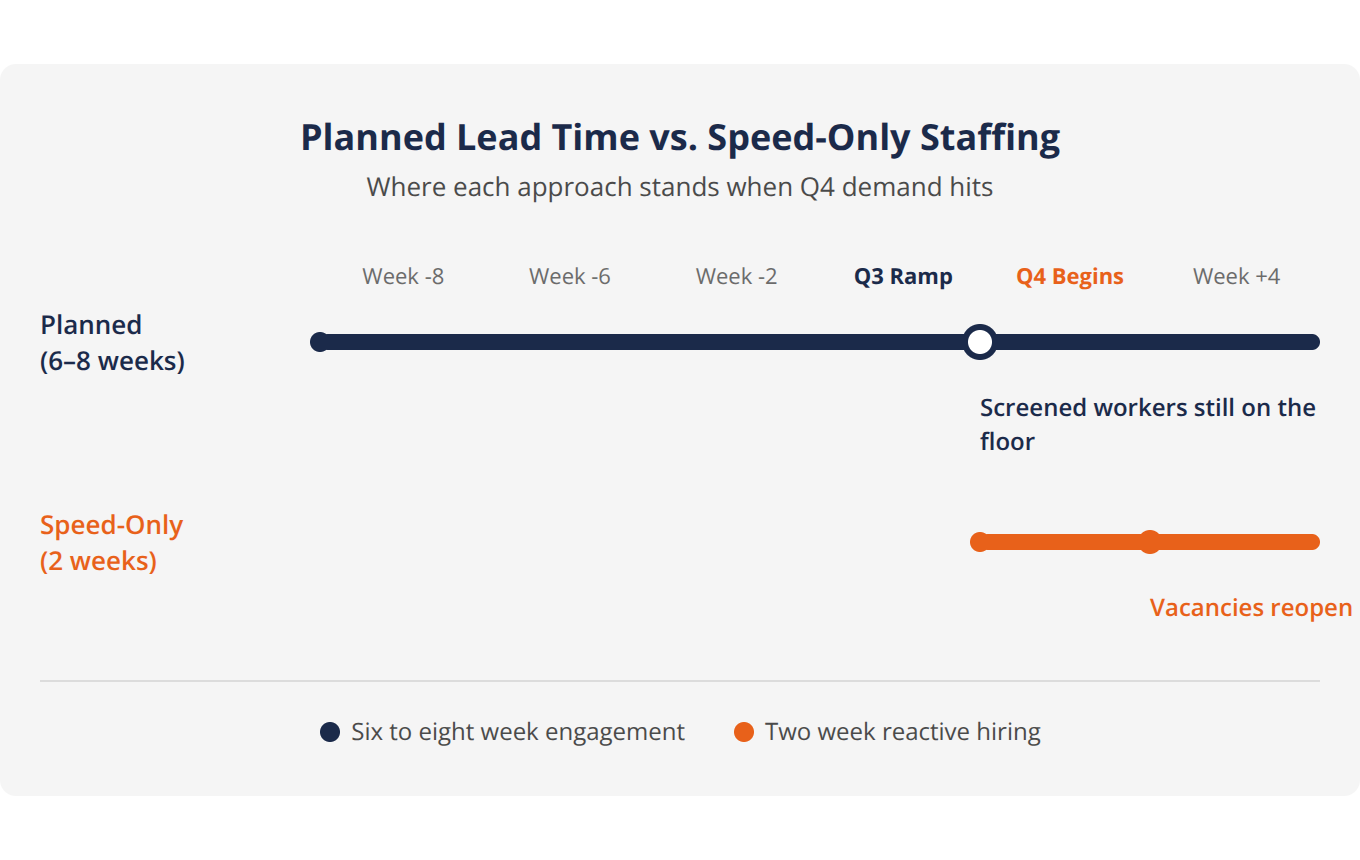
Engaging your staffing partner six to eight weeks out gives them room to source and screen against that existing benchmark, not race against it. Anything shorter and you're not planning a surge anymore, you're reacting to one, and reactive hiring is where screening gets cut first.
Lay that six- to eight-week window next to a rushed one, and the difference in outcomes becomes obvious fast.
Your Staffing Partner Needs More Than A Headcount
Most surge requests start and end with a number. Your staffing partner needs more than a body count to source workers who last past the surge. Tell them what the role looks like once volume normalizes, not just what it looks like at peak.
If the position folds back into standard production runs after Q3, say so. If it disappears entirely once the ramp ends, say that too. A staffing partner sourcing against an accurate picture of the role's full lifecycle screens differently than one sourcing against a shift to fill by Friday.
Read More: How to Hire Fast Without Compromising Quality
Screen Criteria That Predict Q4 Retention, Not Just Q3 Availability
Availability answers one question: can this person start Monday? It says nothing about whether they'll still be on your line in November.
The criteria that actually predict retention look different, things like prior experience with sustained production environments, stated interest in ongoing work rather than short-term assignments, and reliability patterns from previous placements.
None of that shows up if the only filter is who can start immediately. Screening for fit alongside availability takes longer upfront, which is exactly why the six to eight week window matters as much as it does.
Check-Ins During The Surge Catch Disengagement Early
Screening well at the start doesn't mean the work is finished. Workers who were a strong fit on day one can still disengage once the pace of a surge wears on them, and that disengagement is usually visible before it turns into a resignation.
For instance, Allied OneSource builds check-in points directly into surge placements, not as an afterthought but as part of the same planning process that starts six to eight weeks out. Catching a worker who's checking out in week three gives you time to address it before Q4 arrives short-staffed again.
Plan Your Q3 Headcount Before The Ramp Starts
Q3 volume is coming. Allied OneSource plans surge headcount with you far enough in advance that the workers placed during the ramp are still on the floor when Q4 arrives. Start that planning now, before the orders do, reach out to us today.
References
1. Mid-America Regional Council. "Kansas City Metro's 2026 Economic Outlook." MARC, www.marc.org/news/economy-housing/kansas-city-metros-2026-economic-outlook. Accessed 9 July 2026.
2. American Staffing Association. "Staffing Employment and Sales Rebound in Fourth Quarter." American Staffing Association, 30 Mar. 2026, americanstaffing.net/posts/2026/03/30/employment-and-sales-rebound-in-q4/.
3. Society for Human Resource Management. "The State of Recruiting 2025: Insights to Maximize Recruitment from SHRM's New Benchmarking Report." SHRM, 20 Oct. 2025, www.shrm.org/executive-network/insights/people-strategy/state-of-recruiting-2025-insights-to-maximize-recruitment.