
Most employers managing multiple staffing vendors evaluate each one on its own terms: this agency's fill rate, that one's show rate, the other one's response time. What rarely gets priced is the cost of running those relationships in parallel. Coordinating across vendors, reconciling inconsistent screening standards, and absorbing the administrative work that falls between vendor responsibilities all add up.
None of it shows up on an invoice. This article is about whether consolidating those relationships into one accountable partner reduces your overhead or introduces new risk, and how to tell the difference before you make the move.
What Multiple Staffing Vendors Actually Cost You
The costs of managing several staffing relationships rarely surface as a single line item. They show up in how your team spends its time, how consistently placements perform, and who you can actually hold accountable when something goes wrong.
No Vendor Is Accountable for Your Overall Workforce Performance
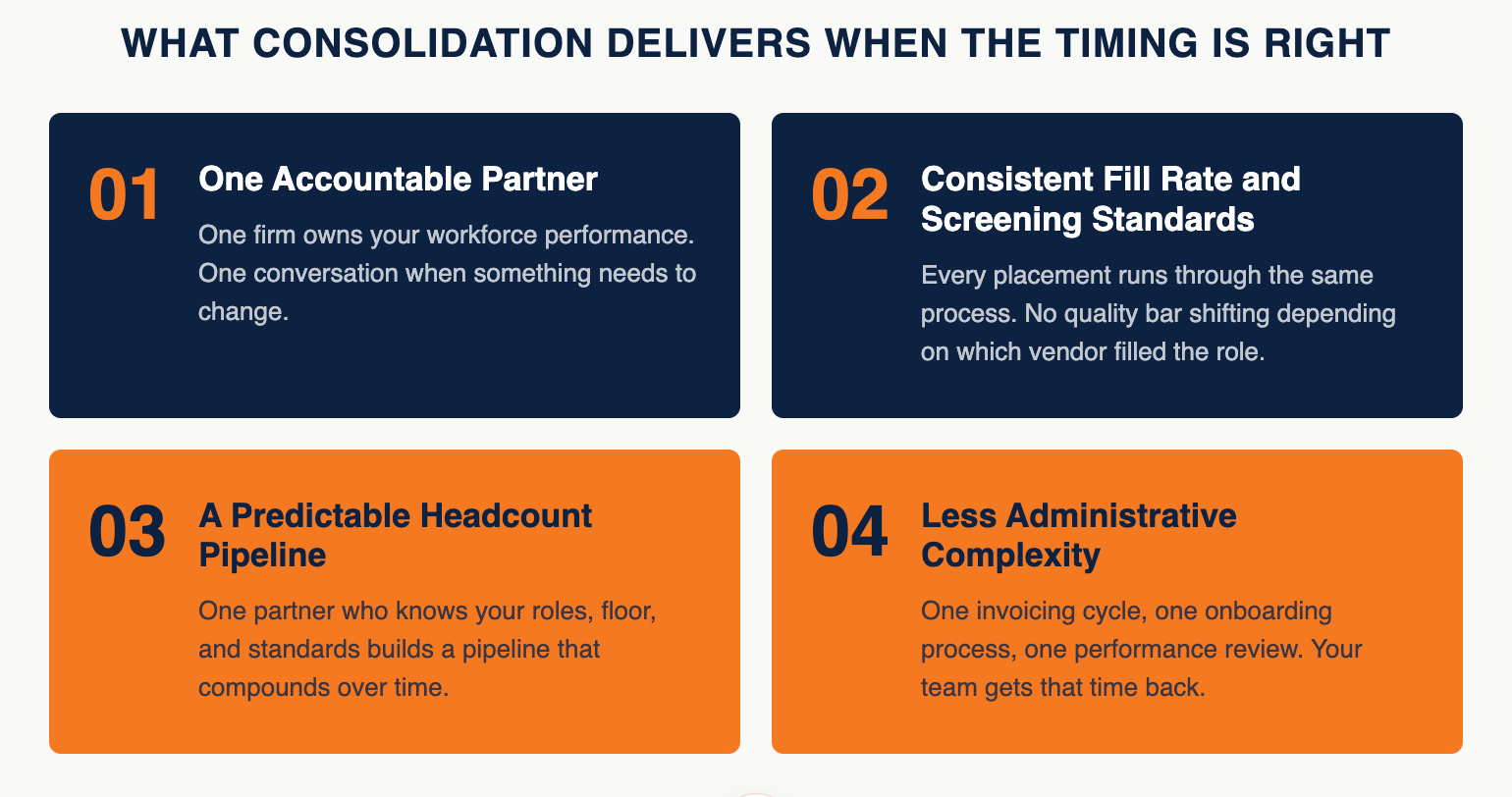
When you run three vendors simultaneously, each one is accountable for its own placements and nothing beyond that. If your overall fill rate is soft, each vendor can point to the others.
If show rates vary across shifts, there is no single partner to bring that pattern to. The accountability gap is a structural feature of running a fragmented vendor mix, not a flaw in any one vendor.
That gap has a practical cost. When no firm owns your workforce performance as a whole, your internal team fills that role by default, tracking patterns, managing escalations, and trying to build a coherent picture out of data that was never designed to be compared.
Fill Rate and Screening Standards Shift From Vendor to Vendor
Every staffing vendor runs its own screening process. One firm may conduct structured skills assessments and reference checks before submission.
Another may compress those steps to move faster. That inconsistency produces a workforce where the quality bar shifts depending on which vendor filled the role, and it is hardest to spot until it shows up in retention numbers or supervisor complaints.
It also makes improvement difficult. If you cannot isolate which vendor's process produces placements that stay past 90 days, you cannot make a targeted decision about which relationship to keep.
Your Team Absorbs the Coordination Work Vendors Don't
Every additional vendor adds coordination overhead that lands on your internal team. Purchase orders, invoicing cycles, onboarding documentation, and performance check-ins all multiply as headcount needs grow.
Deloitte's 2025 Global Chief Procurement Officer Survey found that 57% of CPOs cite siloed working as a top barrier to delivering value.¹ A fragmented vendor mix is a structural silo, and each firm operating with its own processes and reporting formats makes it harder to see your workforce as a whole.²

How To Know If You're Ready To Consolidate
Consolidation makes sense for some operations and creates new risk for others. The difference comes down to whether your current headcount needs can be met by a single partner without gaps during or after the transition.
Can One Partner Actually Cover Your Full Role Mix
The first question is not whether consolidation is a good idea in principle. It is whether a single firm can cover the roles and volume you need without creating new gaps. A partner who handles light industrial well but has thin coverage in skilled trades will solve your coordination problem and introduce a fill rate problem at the same time.
Before you consolidate, map your requisitions by role type, shift, and volume. If a prospective partner cannot speak specifically to coverage in each area, that is your answer before the conversation goes further.
Audit What Each Vendor Is Actually Delivering Before You Switch
Consolidation works best when it is a decision made from data, not frustration. Pull fill rate, show rate, and 90-day retention numbers from each current vendor before you move. If one is consistently outperforming the others, that is worth knowing before you exit the relationship. That audit also gives you a baseline to hold a consolidated partner to.
Without it, you are trading a fragmented mix for a single relationship with no standard to measure against. The Hidden Cost of Switching Staffing Partners lays out what that transition typically costs before it pays off.
Moving Too Fast Is How Consolidation Fails
A consolidation that outpaces your new partner's ramp-up creates a coverage gap. Outgoing vendors wind down their pipelines. The incoming partner has not yet built sourcing depth for your volume. That window is where shifts go uncovered.
The timing is the problem, not the decision. Moving on a contract renewal cycle rather than mid-contract gives your new partner the lead time to source and screen before your outgoing vendors exit.
One Partner Means One Standard for Every Placement
A single partner changes the performance conversation entirely. One fill rate, one show rate, one 90-day retention number across every role you need staffed. When performance dips, there is one conversation to have and one process to examine. For employers evaluating a deeper partnership model, RPO Explained covers what a fully integrated staffing relationship looks like at scale.
Thinking About Consolidating Your Staffing Vendors?
Allied OneSource covers light industrial, skilled trades, professional, and technical roles across the KC metro. Before you make the move, we will walk through whether your current headcount needs fit a consolidation model. Let's talk.
References
1. Deloitte. "2025 Global Chief Procurement Officer Survey." Deloitte, 19 Aug. 2025, www2.deloitte.com/us/en/about/press-room/2025-chief-procurement-officer-survey.html.
2. Staffing Industry Analysts. "A Tool for All Seasons." Staffing Industry Analysts, 25 June 2023, www.staffingindustry.com/editorial/staffing-industry-review/tool-all-seasons.