
Hiring IT talent in 2026 means competing for specialists who are in short supply. Demand for AI, cloud, and cybersecurity skills is rising faster than the number of qualified candidates. Companies that guess at pay instead of using real market data are losing talent to better-prepared competitors. If your last IT hire took too long or you're not getting qualified applicants, your salary assumptions might be outdated.
Whether you're building a tech team or filling urgent gaps, knowing what the market pays is what separates successful hires from lost talent.
What's Driving IT Salary Growth in 2026
Tech compensation is concentrating in roles tied to AI, cloud infrastructure, and cybersecurity, while stagnating for generalist positions.
- AI skills command a specialist premium. More than half of U.S. tech job postings now require AI or machine learning skills, 53% in November 2025, up from 29% a year earlier.¹ DevOps engineers, cloud architects, and software developers are all expected to work with AI systems.
- Organizations are competing for the same talent pool. Eighty-four percent of companies plan to increase their AI investments in 2026.² When everyone needs cloud engineers and cybersecurity analysts at once, salaries rise faster than general inflation.
- Specialists earn more than generalists. The market has shifted toward specialists who can deploy AI in production environments, secure complex cloud systems, or architect data pipelines. Forward deployed engineers; professionals who implement AI solutions directly with enterprise clients, are now considered the hottest role in tech, commanding premiums over traditional developer positions.¹
- Cloud infrastructure spending continues to expand. Ongoing cloud migration and AI workload demands keep hiring strong for cloud engineers, network architects, and database specialists who can scale systems efficiently.
2026 IT Salary Ranges: What Top Roles Command
Here's what the market is actually paying for high-demand tech positions and where competition is fiercest. For complete information, download our salary guide.
Cloud Engineers
Cloud engineers command $82,469 to $206,065 in 2026, with experienced professionals routinely hitting the upper end in competitive markets. The wide range reflects the gap between entry-level administrators and senior architects who design multi-cloud strategies and optimize infrastructure costs.
Cybersecurity Specialists
Senior cybersecurity analysts earn $96,728 to $180,463, while information security managers command $126,139 to $178,205. These ranges have climbed as breach costs and regulatory requirements intensify. Companies need professionals who can secure AI-enabled systems and manage compliance across multiple frameworks.
DevOps Engineers
DevOps engineers earn $70,380 to $119,025. The role requires automation expertise and CI/CD pipeline management. Mid-range salaries typically land around $95,000, with top performers pushing past $110,000 in high-cost markets.
Data Engineers and Architects
Data scientists and cloud data specialists both range from $82,469 to $206,065, while data architects command $103,500 to $186,300. These roles are essential for implementing AI. Companies competing for AI talent often pay toward the higher end to attract candidates who can build production-ready systems.
Full Stack and Python Developers
Full-stack developers and Python developers both earn $77,625 to $144,900. Python's versatility—used in web development, data analysis, AI, and automation keeps demand steady. Full-stack developers remain valuable for smaller teams.
How to Use Salary Data When Hiring Tech Talent
Knowing market rates is only useful if you apply them strategically. Here's a framework for thinking about where to stretch your budget and where you have flexibility.
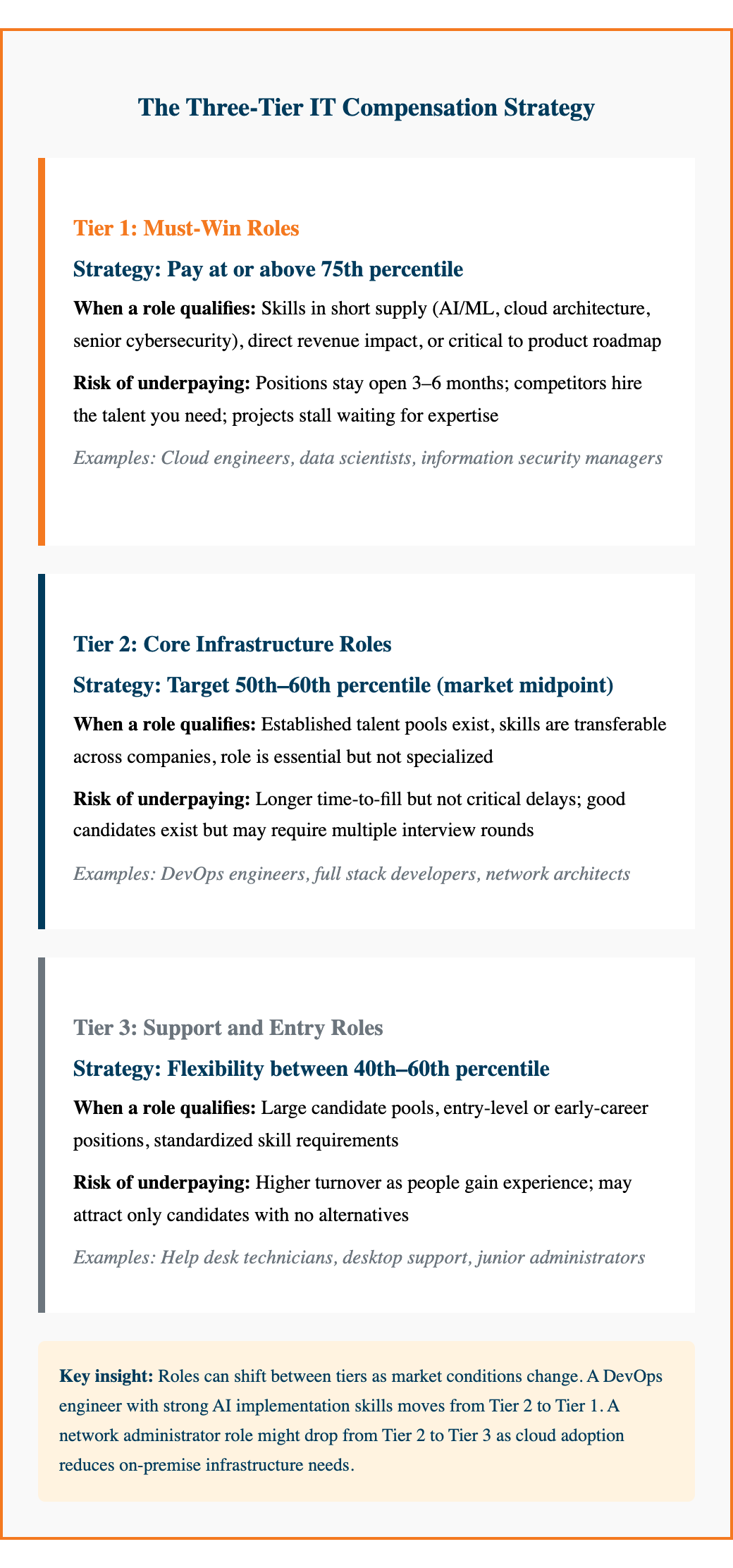
Tier 1: Must-Win Roles (Pay Premium or Lose Talent)
These are the positions where underpaying costs you months of open requisitions or forces you to settle for underqualified candidates. Cloud engineers, senior cybersecurity analysts, and data architects fall into this category.
If you're hiring a cloud engineer with multi-cloud expertise, offering $90,000 won't attract senior talent, you'll get junior candidates or no applicants at all. Pay at or near the top of the range for roles tied to AI, cloud infrastructure, and security.
Tier 2: Core Infrastructure Roles (Meet Market Rate)
DevOps engineers, full stack developers, and network engineers are critical but not facing the same bidding wars as Tier 1 specialists. You don't need to lead the market here, you need to match it. Aim for the midpoint of salary ranges and compete on total compensation, team quality, and project scope.
Tier 3: Foundational Roles (Balanced Market Approach)
Help desk technicians and desktop support specialists give you more flexibility. You can pay slightly below midpoint if you offer strong training programs, clear career paths, or remote work options. Focus on retention through development opportunities rather than leading with salary.
Factor in Total Compensation, Not Just Base Salary
Candidates might accept lower base pay for equity, better benefits, or remote flexibility. Cybersecurity professionals often value training budgets and conference attendance as much as salary. Don't assume base pay is the only lever you have, especially for senior technical roles where professionals are evaluating long-term growth and work-life balance.
Use Data in Negotiation Conversations
When candidates push back on your offer, reference market data without being defensive. "Our range for this role is $82,000 to $120,000 based on regional IT salary data. We're offering you $105,000 because of your cloud automation experience, which puts you in the 70th percentile for this position." This shows you've done your research and positioned the offer fairly within the market.
Plan for Retention, Not Just Hiring
Salary guides help you hire, but retention requires ongoing market awareness. Conduct compensation reviews twice a year, especially for high-demand roles. When a team member completes AWS certifications or takes on AI infrastructure projects, adjust their pay before they start interviewing elsewhere. Waiting too long to recognize increased value costs far more than a proactive raise.
Partner with IT Staffing Experts Who Know the Market
Allied OneSource helps companies recruit and retain tech professionals across cloud engineering, cybersecurity, DevOps, and data roles. With our newly launched St. Louis tech division and decades of staffing expertise, we understand what it takes to close tech hires in competitive markets.
Download the full 2026 Salary Guide or contact us to discuss your tech hiring needs.
References
1. Joslyn, Heather. "Tech Hiring in 2026: The Rise of the Specialist." The New Stack, 5 Jan. 2026, https://thenewstack.io/tech-hiring-in-2026-the-rise-of-the-specialist/.
2. "CompTIA IT Industry Outlook 2026: Embracing Innovation and Seeking Growth." CompTIA, https://www.comptia.org/en-em/about-us/news/press-releases/comptia-it-industry-outlook-2026-embracing-innovation-and-seeking-growth/.